


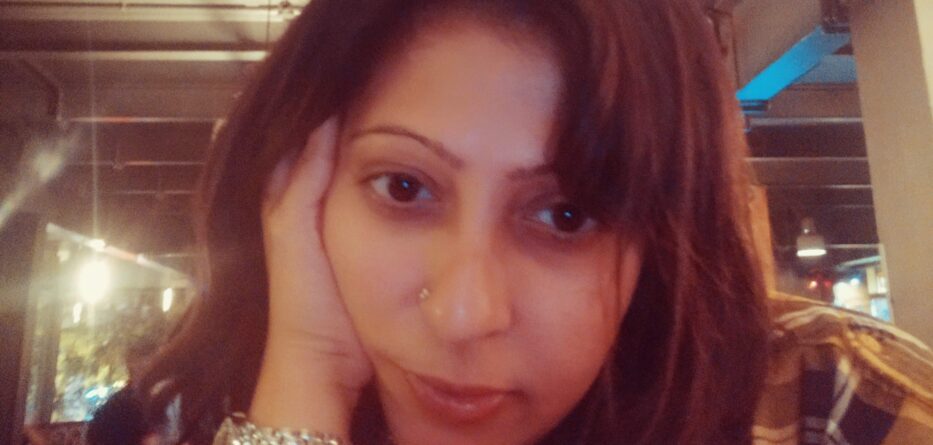
Alpa Arora is a former journalist/content writer who has been writing articles, poetry and short stories for the last 25 years. Her work has been published in The Times of India, Bengaluru Review, Kitaab, Borderless Journal and 1455 Arts. In 2025, she published a collection of poetry titled Please Don’t Tell Me To Calm Down, that is available on all leading global e-commerce platforms. Floating Worlds is her debut novel.
Alpa grew up in the serene colony of Bhabha Atomic Research Centre (BARC) in Mumbai, where her father worked as a nuclear scientist. She completed her Bachelors in English Literature from St Xavier’s College, Mumbai, under the guidance of the late renowned Indian poet Eunice de Souza, who inspired her to write about the thought processes of women in an unabashed manner.
After completing her Diploma in Journalism and Mass Communication from Xavier Institute of Communications (XIC), Alpa joined The Times of India, Mumbai as a city reporter. She moved to Pune in 2001, where she worked as a sub-editor/reporter at The Times of India Pune office. After completing her Masters in English Literature from Mumbai University through distance education, she moved back to Mumbai in 2004. She joined Netscribes (Mumbai) as a content writer and finally made a switch towards E-learning. At the E-Learning company, LearningMate (Mumbai), she learnt the ropes quickly, making a transition from instructional writer to project manager in a span of four years. In 2009, she self-published her online book of short stories on Lulu.com titled Tomato Sauce and Tomato Ketchup.
After moving to Bangalore in 2011, Alpa Arora focused on her family life raising two intelligent boys. Her short story, The Umbrella was published in the online literary journal Bengaluru Review in 2018. In 2019, she started Svaaro Naturals, her home-grown brand of therapeutic and cosmetic products using essential oils. In 2020, she was mentioned, along with her brand Svaaro on the lifestyle portal LBB in a list of ‘Top 30 Business Mums and the Awesome brands they created’.
Alpa is fascinated by human psychology and the wondrous workings of the subconscious mind, that find a creative outlet in her writing. In 2020, she started delving deeper into spiritual healing, which finally led to the inspiration behind writing Floating Worlds, her first novel that explores the marriage of spirituality with psychology as an answer to our everyday existential crises.
She is married to Faizaan Marolia, an IIT-B graduate who is trained in classical guitar from Trinity College of Music and works as a software manager with Google, Bangalore. When she is not busy keeping abreast of Internet meme culture thanks to her two sons aged 10 and 13, she seeks out literary inspiration in the symbols of nature. She possesses a remarkable ability to fabricate realms, preferring to reside in Bengaluru for its agreeable weather.
Team Ananke spoke to Alpa Arora about Floating Worlds, her first full-length novel, her creative process, and the process behind her craft.
Team Ananke: Ruby’s escapism and her ability to slip between past, present, and fantasy drives much of the story. Can you share your process in crafting these transitions so that readers can follow her inner world?
Alpa Arora: The transitions between the past, present, and fantasy were planned using memory triggers. Since I was attempting to use the stream of consciousness style of narration, the aim was to capture the inner thoughts of the character, and in a majority of the cases, these thoughts come fast in a chaotic manner often triggered by an image, a smell, a conversation, a dream or an encounter with another character that serves as a mirror to a hidden aspect of one’s own thought process.
At the same time, I had to ensure that they are not random and help drive the narration forward without seeming pointless. For example, a past scene where Ruby confesses to her friend Kavita that she has lost herself because of being a mother, but at the same time has made her peace with it, comes immediately before the scene where Ruby finally reveals her sadness at losing herself to her son, Trilok. But here she reclaims her space as an individual first, making her son understand that she cannot sacrifice her needs for anyone anymore. So, in a way, the montages are playing off against each other, either to reveal what has happened or what is going to happen. The narrative was plotted in a way to let everything come together in the end.
Team Ananke: The spiritual journey in Floating Worlds—from Raghu’s guidance to the retreat in Narkanda—is very vivid. How did you research or experience these spaces and practices while writing Ruby’s transformation?
Alpa Arora: A lot of the spiritual information comes from my own journey of self-discovery and a constant need to ask tougher questions. I have been on a personal quest to better myself, but in the book, the master and the disciple were both me. I think of it as the unaware and the aware self that we all possess inside us, the earthly self and the enlightened self, they are all in us. I did do a lot of research regarding the women’s retreat, as these are still not very common in India. I would read up on such women’s retreats, watch videos on things like womb healing or the effects of ice baths on the body, and made up my own itinerary for the same. The movement circle is something I personally participated in at a spiritual retreat, and the guided meditation is inspired by my own hypnotherapy sessions at a therapist’s office. I did travel to all the places mentioned there including the Shimla Water Catchment Centre, Mashobra, Narkanda, and Fagu because I wanted to do justice to the landscape where these scenes were set.
The transitions between the past, present, and fantasy were planned using memory triggers
Team Ananke: The novel explores themes of mid-life crisis, female desire, and self-reinvention. Were there personal experiences, observations, or particular stories that inspired Ruby’s arc, or was it mostly imagined?
Alpa Arora: There are parts of Ruby’s story that come from my own childhood or youth. So does the mid-life crisis. I too gave up the idea of pursuing my own career to raise my two children, and I understand the battle between the mother and the individual very well. But eventually, there comes a point where one stops blaming others for one’s own life choices, and the balance is restored to the self as the kids become more independent. I personally do not think any woman has had it easy; neither the one who feels shame at abandoning herself, nor the guilt the other one experiences, the one who decides to put her career or passion first. As for female desire, the understanding comes from numerous conversations with other women as well. Female desire peaks in middle age, as does female loneliness, and it is disheartening that women are assumed to lose their vitality in their forties and fifties, when it is the opposite that is happening, because these women are finally learning to understand their own bodies without depending on a man’s validation for the same.
Team Ananke: Imaginary worlds, sexual fantasies, and past trauma are woven together in Ruby’s narrative. What were the challenges of balancing these elements without overwhelming the emotional resonance of the story?
Alpa Arora: The challenge lay in ensuring that the plot does not get lost in the inner workings of the protagonist’s mind. Because at the end of the day, it is the plot that makes the story, along with the characters. The plot was very simple as opposed to the main character. Here is a woman who is lost, at least she seems lost and hopeless in the beginning. Why is she lost, and how is she going to find herself? And in the process, how does one make the reader relate to this lost woman, root for her, along with actually questioning her life choices that she so unabashedly makes, and then wonders about? It was also important for me to add other interesting characters that aren’t too squeaky clean in contrast to this flawed protagonist. Her aunt, Nina, represents a possible future version of what Ruby could become if she just embraced her flaws completely. The reader needs to sympathize with Ruby’s husband, but at the same time not hate Ruby for not wanting to be with him. They need to see how balanced and open minded Riyaz is, but at the same time realize that these are the very qualities that can make him self-centered. And that Ruby’s fixation for Shiv stems from the fact that he is practical and restrained, traits she does possess herself but does not acknowledge till the very end of the book.
Team Ananke: Your cover art, created by Anita Saran, captures Ruby’s journey visually. How involved were you in the design process, and what was your vision for how the cover should reflect the novel’s themes?
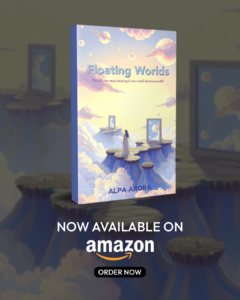
Alpa Arora: I had met Anita Saran for the first time at one of her art exhibitions in Bangalore. We kept in touch over social media, and I really look up to the way she depicts female energy, whether it is through her Kali series of paintings or her AI-inspired futuristic Goth artwork. She is an artist to watch out for. I had the idea for the cover image in my mind, and I shared my brief with her, to which she has done complete justice, and a lot of people have praised the cover of the book as well. I wanted it to be dreamy, magical, and show a woman at the threshold of different portals or windows of time with imaginary worlds in the background, and that is exactly what Anita came up with.
Read the full review of Floating Worlds by Alpa Arora on Ananke Mag
Team Ananke: Floating Worlds often references the reclaiming of feminine power and self-acceptance. How did you decide which moments of vulnerability or liberation to highlight for Ruby, and were any scenes particularly challenging to write?
Alpa Arora: I wanted the first two parts of the book to capture Ruby’s fragile state of mind and the last two to highlight her healing journey. Hence, the first half of the book contains most of the scenes where Ruby is constantly breaking down and reaching out to people she trusts for help. I built up the scenes keeping in mind the overwhelming nature of anxiety and the release and tiredness that follow from constantly fighting a battle with your own mind. It is exhausting, and breakdowns or panic attacks are usually followed by a numbness that causes further dissociation from the soul energy.
The challenging scenes for me were when Ruby keeps trying to fall back on Shiv for answers because there had to be a vulnerability here that shows up in one-sided love. Shiv keeps telling her that they can’t be more than friends, and yet she keeps reassuring herself that he is lying and that someday he will realize the truth. The reader gets to see how far away from reality she has drifted off, and yet can do nothing to help her till she is ready. Also, the scene depicting child sexual abuse was extremely difficult to write because of the graphic nature of the content, which required me as a writer to not hold back or keep the details superficial.
Team Ananke: After 25 years of writing articles, poetry, and short stories, how did your approach to writing a full-length novel differ, and what did you discover about your own creative process while writing Floating Worlds?
Alpa Arora: I discovered that I could write a novel! But I also learnt that writing a novel requires a framework. You can’t just sit down and write off a whole novel unless you strategize, improvise, do your research, and sit down every day with discipline and enough time to write it. There are days when one wants to give up on it because it is just too much of digging into your own head, and days when you just want to keep writing without performing any of your other responsibilities, because you are finally in the flow.
I recall T.S. Eliot’s advice about writing to a young writer, where he said,
“But nobody can tell you how to start writing. The only good reason for writing is that one has to write.”
I am the same person who can write a poem in a state of utter passion without halting for a second, but I can’t do that with a novel because there I have to plan things beforehand. The whole process of writing is personal, and everyone does it in a way that seems right to them. That is what makes each piece of writing so unique from the others.
About the Book
“Aren’t you tired of running by now, Ruby?”
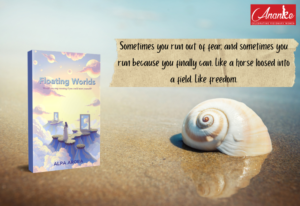
“Shiv, there is a difference between running and staying. Also, sometimes you run out of fear and sometimes you run because you finally can. Like a horse running wild on a field. Merely because it can.”
Ruby Khanna, a former scriptwriter and Empty Nester is going through a mid-life crisis. Her coping mechanisms consist of conjuring up sexual fantasies, escaping into imaginary worlds and self-sabotaging her existing marriage. But Ruby has always been an escapist, even as a child, seamlessly travelling between past and present and unable to differentiate between reality and phantasm. Infatuated with Shiv, a younger psychiatrist, she continues to mentally unravel till her frustrated husband, Kabir demands a divorce, Ruby is then forced to begin her healing journey, guided by Raghu, an adman turned spiritual guru.
In order to move ahead, Ruby must first stop running away to face her fragmented selves. She finds a sense of acceptance at her aunt’s home in Mashobra, where she meets the free-spirited Riyaz, who teaches her how to live without judgement. When she attends a spiritual retreat on reclaiming the Feminine Goddess in Narkanda, Ruby bonds with other women just like her and learns to release her past trauma.
But things get precarious once again when she is forced to make a difficult choice. Will Ruby continue living in imaginary worlds or finally confront her reality?
Disclaimer: This page has affiliate links.



)