

There is, at the heart of The Tree, the Well & the Drag Queen (Red River Press, 2026), a trembling proposition: that inheritance is not land or memory, but a rehearsed, enforced, and, occasionally, resisted script. In this slender yet resonant novella, Salini Vineeth conjures a world where myth is neither past nor metaphor, but an active architecture shaping the possibilities of selfhood. What emerges is a work that is at once intimate and expansive, rooted in a distinctly subcontinental imagination while speaking to broader questions of identity, embodiment, and autonomy.
Salini Vineeth arrives at The Tree, the Well & the Drag Queen with a body of work shaped by movement—across professions, forms, and languages. An alumna of BITS Pilani, she spent a decade as an engineer before turning to full-time writing in 2019, a shift that echoes, in its own way, the book’s preoccupation with departures from prescribed paths. Her oeuvre—spanning the novel Lost Edges, the novella Magic Square, the short story collection Everyday People, and travel writing on places like Hampi and Badami—reveals a sustained interest in the textures of ordinary lives and the quiet fractures within them. As a translator from English to Malayalam and fiction editor at Mean Pepper Vine, Vineeth is also deeply attuned to the nuances of voice and cultural memory. These sensibilities find a particularly resonant expression in this latest work, where questions of inheritance, self-fashioning, and the pull of origin are rendered with both intimacy and imaginative reach. Her recognitions—from the Orange Flower Award for Humour to accolades at the Mumbai LitFest and the BWW RK Anand Prize—trace a career attentive to craft, but it is in this novella that her thematic concerns seem to gather a new, haunting clarity.
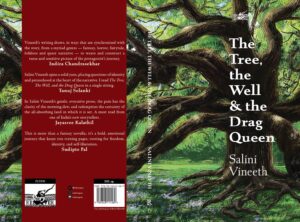
The premise of this novella is deceptively simple, even fable-like: a Mumbai-based drag performer returns to their ancestral village, drawn into a confrontation with a monstrous jackfruit tree, an entity that is less a creature than a system, less a curse than a continuity. Yet Vineeth resists the easy binaries of modern versus traditional, city versus village, freedom versus constraint. Instead, she offers a more unsettling terrain, where the past is not left behind but lies in wait, patient and sentient, insisting on its due.
The jackfruit tree itself is one of the novella’s most striking achievements. It belongs to a lineage of literary presences that are at once ecological and symbolic, recalling, perhaps, the haunted landscapes of regional folklore or the animistic textures of oral storytelling traditions. But Salini Vineeth’s tree is an organism of control, fed by generations of compliance. Its grotesque abundance—jackfruit, after all, is a fruit of excess, of stickiness and weight, becomes an apt metaphor for inherited burdens that cling, refusing to be easily shed.
What is particularly compelling is how Salini Vineeth situates this mythic structure within a contemporary narrative of self-fashioning. The protagonist’s life in Mumbai, though sketched with restraint, gestures toward a space of possibility where performance becomes a mode of articulation, identity can be assembled, experimented with, and, crucially, claimed. Still, the return to the village complicates any notion of linear progress. The past is not a closed chapter but a recursive force, pulling the protagonist back into a web of obligation and fear.
This tension between self-invention and inherited script forms the emotional and philosophical core of the novella. Vineeth approaches it with a notable gentleness, resisting sensationalism even as she navigates themes that could easily veer into the didactic or the melodramatic. The prose is measured, often luminous, carrying within it a quiet attentiveness to landscape and interiority alike. There are moments where pain is rendered with a clarity that feels almost tactile, and others where the possibility of transformation flickers, tentative yet persistent.
For a Global South feminist readership, The Tree, the Well & the Drag Queen by Salini Vineeth offers particularly fertile ground for reflection. Its engagement with lineage and duty resonates with long-standing conversations around the weight of family, the disciplining of bodies, and the often invisible labour of conformity that is rarely named as such, yet structures everyday existence with quiet insistence. In many contexts across the Global South, kinship is not merely an affective network but a regulatory one, where belonging is negotiated through adherence to roles that are at once intimate and deeply surveilled. Vineeth’s narrative inhabits this terrain with sensitivity, revealing how expectations are internalised not only as obligation but as a kind of emotional grammar, shaping how one moves, desires, and even imagines a future.
Importantly, Vineeth does not frame these concerns in overtly theoretical terms, nor does she impose a rigid ideological scaffolding upon the story. Instead, she allows them to emerge through narrative texture: through the rhythms of village life that mark time differently from the city, through the silences within families that speak as forcefully as words, and through the unspoken rules that govern belonging, that are learned early, often without articulation, and enforced through gesture, glance, and withdrawal. The novella attends closely to these micro-practices of regulation, suggesting that power is not only exercised through grand prohibitions but through the subtle calibrations of everyday life.
Read more Book Reviews by Team Ananke
What also becomes visible, in this rendering, is the gendered asymmetry embedded within such structures. Expectations are unevenly distributed, and the cost of deviation is not borne equally. Without being declarative, the text gestures toward how certain bodies are made to carry the burden of continuity more heavily than others. How they become sites where family honour, social anxiety, and cultural memory converge. The protagonist’s unease, then, is not simply personal; it is symptomatic of a larger system that demands coherence at the expense of plurality.
At the same time, the novella resists reducing this world to a monolith of oppression. There are fleeting intimacies, moments of care and complicity, reminders that the very structures that constrain are also those that sustain. This ambivalence is crucial. It allows Salini Vineeth to avoid the trap of easy binaries, like tradition versus modernity, village versus city, and instead presents a more entangled reality, where the desire for selfhood must be negotiated within, rather than entirely outside, inherited frameworks. In doing so, the text opens up a space for thinking about resistance not as rupture alone, but as a series of subtle, sometimes fragile, acts of reorientation.
The text invites a more layered reading of resistance. The protagonist’s departure from the village, their crafting of a life elsewhere, might initially appear as an act of rupture, a clean break from oppressive structures. But the novella complicates this narrative, suggesting that freedom, especially within deeply embedded social matrices, is rarely absolute. The past persists, not only as memory but as a set of conditions that continue to shape the present. In this sense, the confrontation with the tree becomes less about vanquishing an external enemy and more about negotiating the terms of one’s own inheritance.
Salini Vineeth’s blending of folklore, horror, fantasy, and contemporary realism is largely seamless, though not without its moments of unevenness. At times, the shifts in tone can feel abrupt, as though the narrative is straining to hold together its multiple registers. The horror elements, in particular, occasionally verge on the predictable, relying on familiar tropes that slightly dilute the otherwise distinctive atmosphere of the text. However, these are minor inflections in a work that is, on the whole, remarkably assured.
If there is a more substantive critique to be made, it lies in the relative opacity of certain secondary characters, who remain more emblematic than fully realized. Given the novella’s investment in generational dynamics, a deeper excavation of these figures might have enriched the narrative’s exploration of complicity and dissent.
As it stands, the focus remains firmly on the protagonist’s journey, which, while compelling, sometimes leaves the broader social fabric less textured than it could be.
Perhaps this narrowing of focus is also a deliberate choice. By centring a single consciousness, Vineeth underscores the solitude that often accompanies acts of deviation, especially within tightly knit communities where difference is both visible and fraught. The protagonist’s journey is not framed as heroic in any conventional sense; it is marked by hesitation, vulnerability, and an acute awareness of consequence. This refusal of easy triumph is one of the novella’s quiet strengths.
There is also an undercurrent of ecological unease running through the text. The tree, in its monstrous vitality, gestures toward a relationship with the natural world that is both intimate and exploitative. It feeds on human submission, just as it demands human service, blurring the boundaries between the organic and the social. In an era marked by environmental precarity, this entanglement acquires an added resonance, suggesting that the violences we inherit and perpetuate are not confined to human relations alone.
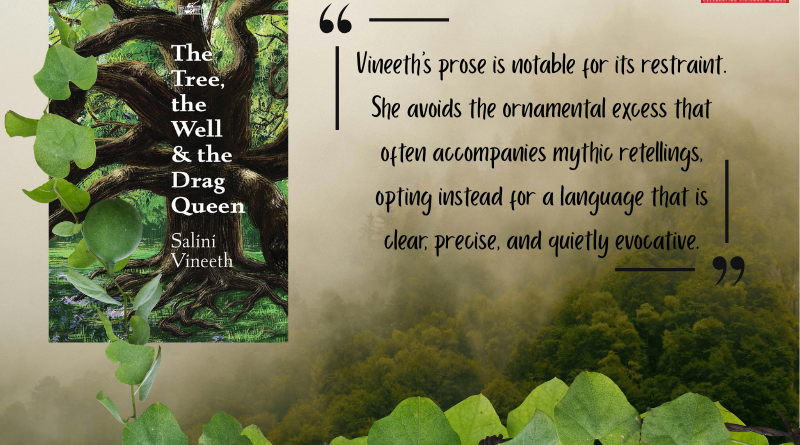
Stylistically, Salini Vineeth’s prose is notable for its restraint. She avoids the ornamental excess that often accompanies mythic retellings, opting instead for a language that is clear, precise, and quietly evocative. This simplicity allows the more fantastical elements of the narrative to emerge with greater force, unencumbered by linguistic overstatement. It also aligns with the novella’s thematic concerns, reinforcing the idea that the most profound transformations often occur not in grand gestures, but in subtle shifts of perception and choice.
In the end, The Tree, the Well & the Drag Queen by Salini Vineeth is less concerned with definitive answers than with the articulation of a question: what does it mean to claim a self in the shadow of inherited worlds? Vineeth does not offer a neat resolution, nor does she romanticize the struggle. Instead, she leaves us with an image of a protagonist who dares to confront the forces that have shaped them, even as they remain entangled within those very forces. This image is at once unsettling and hopeful.
For readers attuned to the complexities of identity, belonging, and resistance within the Global South, this novella offers a quietly powerful meditation. It asks us to consider not only the structures that bind us, but the ways in which we might, however tentatively, begin to loosen their hold.