

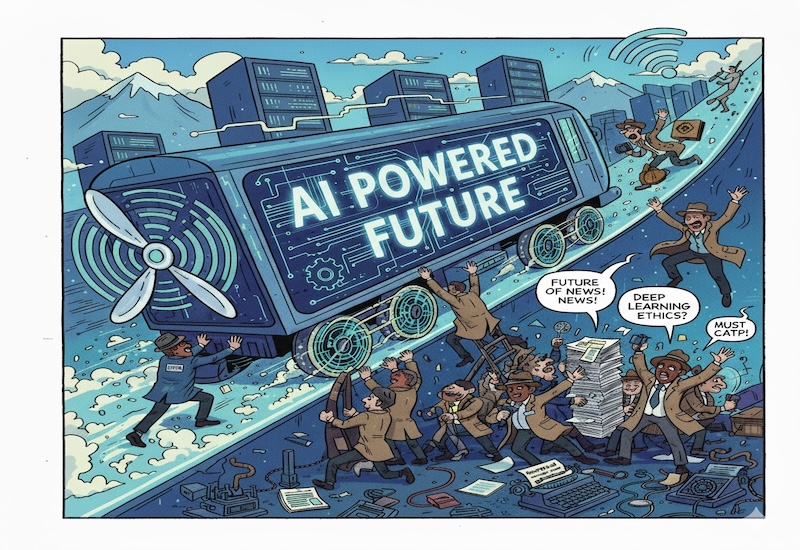
Let’s be honest, we have all jumped on the AI bandwagon but safe to say we are only trying to get on it. Grappling to hold on. And while the world is delving into the notions of agentic AI, voice biometrics, smart automation and data management, we – the publishing community especially in this side of the world – are still obsessing either about publishers getting caught doing a ChatGPT copy-paste (tsk tsk sloppy!!) or how many jobs technology, more specifically AI will devour.
The cat is already out of the bag. But let me nevertheless spell it out, knowing fully well fearful lamentations akin to those in the age of Y2K will continue! Like any other industrial revolution, advancement is most certainly cutthroat and it means job loss – menial and now, not so menial as well. It is a fact and it is happening. But like any industrial revolution in the past, humanity will not just learn to adapt and adopt, it will re-adjust and settle as it has always been the case. The only difference is the depth, scope and speed of innovation. (And we have to keep up.)
But is that really the big question?
One of the leading newspapers in Pakistan, went viral the other day for all the wrong reasons. The newspaper was caught publishing a ChatGPT prompt in its business report. Even though the error was easy to remove from the digital one, it was certainly not the case for its print version. Criticism reverberated across all social platforms like a fire – wild and inflammatory. Regional newspapers, journalists, influencers came out with sharpened shears. Certainly, an overlooked mistake, as if the print form has never contained one or the other mistake in the past! That said, with an AI policy which vehemently boasts ‘human oversight,’ readers question the publication’s most prized, decades-long, journalistic integrity.
In a recently held publishing conference, there was much debate about AI, its uses and of course the fear it germinates across the publishing landscape, the job coup and more. It focused on book publishing in the age of AI, AI tools and strategies, AI for Editorial etc. Numerous relevant and very important topics. Indeed!
But what is missing from all these conversations?
While entities like JournalismAI, which are enabling small newsrooms to leverage the power of AI responsibly, there is a lot to be desired when it comes to news-makers especially in the South Asian journalistic scene.
Recently, a promising digital media platform, Nukta had announced layoffs especially from its Pakistan office as part of its restructuring in less than a year of its launch. True a standalone news website has its challenges, but news organizations and journalists alike are still ignoring the elephant in the room.
It is not merely about SEO or hashtags anymore. Gone are the days of social media presence where traffic is then transferred to the news site. The virtual realm is a living, breathing, dynamic space which is ever evolving, innovating. And its consumers are young and savvy and smart (excuse the pun!).
Who actually is the audience, consumers of information? How information and more importantly news is being produced, distributed and consumed. According to an FT Strategies report ‘The Future of Discovery: Strategic Business Model Choices in the Age of AI Search’: “Over the past two decades, publishers have gradually lost control of how their content is discovered by audiences. With owned-and-operated print businesses, publishers owned their entire value chain from creation, to packaging, to distribution to readers… A large and growing share of consumers rely on “zero-click” searches to find answers without clicking through to websites…. News fatigue (driven in part by an abundance of rolling updates, global coverage and constant push notifications) and increased competition for attention by social and entertainment content against a macro-level backdrop of declining trust in social institutions arguably all contribute.”
The FT Strategies report further states: “Viewed from the news consumer perspective, this is a demand-side shift: the behaviours of news audiences are evolving. Generative AI is changing where people encounter information and how they interact with it, and users are adopting these tools to seek information directly. Success depends on intentionally designing how content meets audience needs, across owned and platform environments.”
 This is an age where Gen Zs meet up, attend concerts and consume information virtually; and they do that by relying on ‘zero clicks.’
Also, in this day and age, transparency as well as quality are essential in the backdrop of plunmeting trust. And with the global climate of hate, distrust and polarisation, tumultuous waters can only be navigated through clarity and vision – one might say oversight!
In an article published on the Center for News, Technology and Innovation (CNTI), the writer assess the benefits and harms of AI in journalism showcasing an AI and Society report 2025 ‘Perceptions of AI-driven news among contemporary audiences: a study of trust, engagement, and impact’: “The survey of nearly 2000 people in 10 African countries found generally neutral trust in AI generated content (though younger people were more receptive). The researchers also found out that (1) awareness of bias did not reduce the trust and (2) participants who valued transparency reported higher trust.”
The Center’s key takeaway from the survey was that the focus was not on the fact that whether or not AI was used but rather the quality of the story.
A digital publishing entity – be it news-centric or something else – needs to thoroughly discern its audience. Merely understanding the different formats and behavioural trends of consumers is just not enough. Strategies should be formulated at the intersection of journalism, technology, ethics and transparency. News and information generation, its packaging and distribution should be an amalgamation, making it engageing for the reader.
Not only that AI tools can alleviate newsrooms from the banality of menial work, it – needless to say – efficiently, cost effetively help make room for impactful and smart journalism by transforming news gathering, production as well as audience engagement.
An IBM article asserts: “Early experiments like the AI-powered news app Artifact, teased some of the potential ways AI might make news more fun, with features like summarize news in the style of gen Z. More often than not, these types of tools enabled journalists to scale up their reporting, cut down on busywork, and decipher relationships or patterns within data they’re scraping from multiple sources. The novelty that generative AI introduces is that it’s able to produce content such as written texts, audio, video and images. In some use cases, generative AI can help editors and reporters translate and transform their stories for different distribution channels. However, the technology can also be hijacked by bad actors to produce disinformation and deepfakes, which makes journalists’ jobs harder.” And here is the junction that makes a journalist’s job relevant and so important!
It is time to fully embrace and leverage the power AI. Hiring a whole lot of personnel only to fire them in less than a year clearly showcases unsustainable business model. Unsustainable not because of any shortcomings in terms of journalistic acumen but perhaps the failure to recognize what it means to be a part of the AI revolution.
And lastly, unsustainability in the publishing landscape severely damages the entire journalistic eco-system. Only a lean staff will just not do, working in silos will just not do. Publishers need to work at the intersection of technology, news gathering, production and distribution. It is time to do away with old business models. It is time to evolve and innovate.