

“Aren’t you tired of running by now, Ruby?”
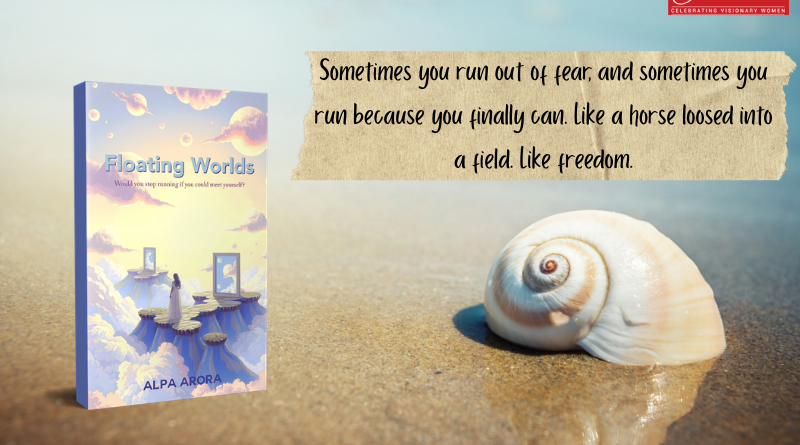
It is the kind of question that sounds accusatory at first, until the reply reframes everything: Sometimes you run out of fear, and sometimes you run because you finally can. Like a horse loosed into a field. Like freedom.
This quiet, almost offhand exchange sits at the emotional core of Alpa Arora’s Floating Worlds, a tender, psychologically intricate novel that examines what it means to escape and what it costs to return. At once a portrait of a woman in midlife crisis and a meditation on memory, desire, and feminine selfhood, the book charts the inner life of Ruby Khanna with rare intimacy, refusing easy judgments or tidy resolutions.
Ruby is a former scriptwriter and recent empty nester whose life has thinned out into domestic routine and muted dissatisfaction. Her days feel staged, rehearsed, faintly unreal. To cope, she retreats into elaborate sexual fantasies, conjures alternate realities, and sabotages the fragile stability of her marriage to her husband, Kabir. What might, in another novel, be presented as infidelity or moral failure is rendered here as something more complicated, a symptom of psychic fragmentation, of a woman who has never quite learned how to stay present in her own life.
Escapism is Ruby’s oldest instinct. Even as a child, she slipped between worlds, drifting between memory and imagination until the boundaries dissolved. The adult Ruby continues to live in this porous mental landscape, where past and present overlap and reality competes with phantasm. Her infatuation with Shiv, a younger psychiatrist, becomes both a fantasy and an emotional anchor, less a romance than a projection of longing, youth, and the possibility of reinvention.
Arora structures the novel to mirror this interior turbulence. Time is fluid rather than linear. Scenes dissolve into memories, fantasies intrude into conversations, and Ruby’s inner monologue frequently overtakes external action. The effect is immersive and occasionally disorienting, but purposefully so: We do not simply observe Ruby’s unraveling, rather, we inhabit it. The narrative refuses the stability of a clear-cut plot because Ruby herself lacks a stable sense of self.
This is one of the greatest strengths of this novel. Arora understands that psychological crisis rarely follows a neat arc. Instead, it loops, repeats, fractures. The prose often takes on a dreamlike cadence, with lyrical descriptions and associative leaps that feel closer to thought than speech. The “floating” of the title is not merely metaphorical; it describes the very texture of Ruby’s consciousness.
And yet, for all its interiority, the novel remains firmly grounded in the realities of middle-aged womanhood, a subject still surprisingly underexplored in Indian English fiction. Ruby’s crisis is not only existential but domestic. The departure of her children leaves behind an echoing silence. Her marriage, once functional if unremarkable, begins to feel like a costume she has outgrown. The roles she has performed, of a wife, mother, and caregiver, have slowly erased the person beneath.
When Kabir, exhausted by her emotional withdrawal and self-sabotage, demands a divorce, it feels less like catastrophe than inevitability. The collapse of the marriage becomes a forced reckoning. With nowhere left to hide, Ruby must confront the selves she has long avoided.
What follows is not a conventional redemption arc but a tentative, often awkward process of healing. Enter Raghu, an adman turned spiritual guide, whose presence risks cliché but ultimately provides gentle scaffolding rather than easy enlightenment. Through him and through a series of journeys away from the city, Ruby begins to reassemble herself.
The settings here matter deeply. Arora’s landscapes are not decorative backdrops but emotional terrains. At her aunt’s home in Mashobra, nestled in the hills, Ruby finds a rare atmosphere of acceptance. The mountains slow her thoughts; the air itself feels cleansing. It is here that she meets Riyaz, a free-spirited, unguarded presence who introduces her to a way of living without constant self-surveillance or shame. Their connection is less romantic than liberating, suggesting that intimacy can be expansive rather than possessive.
Later, at a spiritual retreat in Narkanda focused on reclaiming the feminine Goddess, Ruby joins other women carrying their own invisible burdens. These sections could have tipped into didacticism, but Arora handles them with restraint, allowing solidarity to emerge organically through shared vulnerability rather than slogans. The healing here is messy, imperfect, communal.
If Floating Worlds has a thesis, it is that recovery is not about becoming someone new but integrating the selves one has splintered off to survive. Ruby must learn to stop running, not because running is shameful, but because staying requires a different kind of courage.
Crucially, Arora never asks the reader to find Ruby entirely likable. She is selfish at times, evasive, frustratingly passive. She hurts people. She indulges fantasies that border on delusion. But this refusal to sanitize her protagonist is precisely what makes the novel feel honest. Ruby is not a symbol of empowerment; she is a woman in pain. And pain, Arora suggests, rarely looks graceful.
The supporting characters function as mirrors rather than mere plot devices. Kabir embodies the limits of patience. Shiv represents projection and longing. Raghu offers structure. Riyaz models freedom. Each relationship reflects a different version of Ruby, forcing her to choose which self she wants to inhabit. The novel’s central tension, whether she will retreat into imaginary worlds or step fully into reality, becomes less about plot suspense and more about psychological stakes.
Stylistically, Arora’s prose is reflective and sensuous, often bordering on poetic without losing clarity. She excels at capturing the small textures of inner life: the sudden rush of memory, the bodily ache of loneliness, the peculiar shame of wanting more than one’s life seems to allow. At times, the narrative lingers perhaps too long in introspection, and certain spiritual passages feel repetitive. Yet even these slower stretches contribute to the book’s meditative rhythm. Floating Worlds is not meant to be devoured quickly. It asks to be inhabited.
In the end, what lingers is not a dramatic climax but a sense that Ruby has stopped floating quite so helplessly between worlds. The healing is partial, ongoing, and believable. Arora resists the temptation to wrap everything in certainty. Instead, she offers something more radical: acceptance of ambiguity.
Floating Worlds is a novel about middle age, but also about the selves we abandon to survive and the difficult grace of reclaiming them. It speaks to anyone who has ever felt out of place in their own life, who has mistaken escape for freedom, or who has wondered whether it is too late to begin again.
In Ruby’s story, running is not always cowardice. Sometimes it is preparation. Sometimes it is the gathering of breath before you finally learn how to stay.
Disclaimer: This page has affiliate links.
About the Author

Alpa Arora is a former journalist/content writer who has been writing articles, poetry and short stories for the last 25 years. Her work has been published in The Times of India, Bengaluru Review, Kitaab, Borderless Journal and 1455 Arts. She is fascinated by human psychology and the wondrous workings of the subconscious female mind, which find a creative outlet in her writing. She has also written a fiction novel titled Floating Worlds. She resides in Bengaluru, India and posts her writing on her Instagram page, writeralpa_arora.
About the Book
“Aren’t you tired of running by now, Ruby?”
“Shiv, there is a difference between running and staying. Also, sometimes you run out of fear and sometimes you run because you finally can. Like a horse running wild on a field. Merely because it can.”
Ruby Khanna, a former scriptwriter and Empty Nester is going through a mid-life crisis. Her coping mechanisms consist of conjuring up sexual fantasies, escaping into imaginary worlds and self-sabotaging her existing marriage. But Ruby has always been an escapist, even as a child, seamlessly travelling between past and present and unable to differentiate between reality and phantasm. Infatuated with Shiv, a younger psychiatrist, she continues to mentally unravel till her frustrated husband, Kabir demands a divorce, Ruby is then forced to begin her healing journey, guided by Raghu, an adman turned spiritual guru.
In order to move ahead, Ruby must first stop running away to face her fragmented selves. She finds a sense of acceptance at her aunt’s home in Mashobra, where she meets the free-spirited Riyaz, who teaches her how to live without judgement. When she attends a spiritual retreat on reclaiming the Feminine Goddess in Narkanda, Ruby bonds with other women just like her and learns to release her past trauma.
But things get precarious once again when she is forced to make a difficult choice. Will Ruby continue living in imaginary worlds or finally confront her reality?