


Contemporary fiction by women is frequently forced into false binaries. Books centred on emotional life are often dismissed as soft, while stories concerned with ambition, violence, or sociopolitical rupture are granted greater literary seriousness. Women writers, particularly from the Global South, continue to navigate a literary culture that demands emotional accessibility while simultaneously undervaluing emotional intelligence as intellectual work. Within South Asian literary spaces especially, novels by women are still too often read through narrow frameworks: romance, domesticity, trauma, resilience.
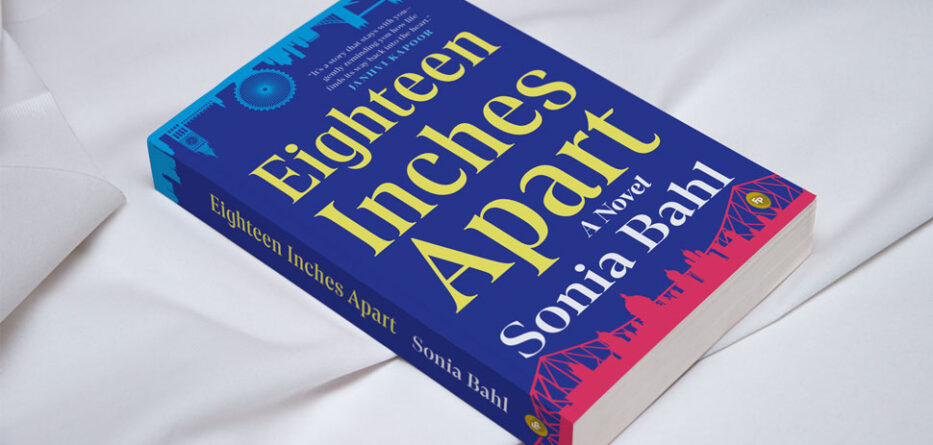
Sonia Bahl’s Eighteen Inches Apart (Fingerprint! Publishing, 2026) resists these expectations.
At first glance, the novel appears deceptively simple. A photographer in Calcutta glimpses a mysterious man outside a café and cannot forget him. In London, a drifting heir named Neel moves through grief and emotional inertia until an encounter with a young street musician alters something within him. Their lives unfold across different cities, emotional landscapes, and invisible threads of coincidence. Yet beneath this understated premise lies a deeply feminist inquiry into emotional attention, feminine ways of seeing, and the invisible labour of feeling in a fractured contemporary world.
The novel’s emotional centre belongs unmistakably to Leela. As a photographer, Leela is trained to notice what others overlook. But Bahl uses photography as a feminist mode of perception. Leela’s gaze is neither extractive, voyeuristic or possessive. Instead, it is deeply attentive. She moves through the world observing emotional residue in ways contemporary urban life often teaches people to ignore. Her encounter with the mysterious stranger outside the café unsettles her precisely because she recognises something emotionally legible in him before she fully understands why.
This act of emotional noticing becomes one of the novel’s most radical gestures. Women, particularly in South Asian societies, are frequently socialised into heightened emotional attentiveness. They are taught to anticipate moods, read silences, manage atmospheres, and notice discomfort before it becomes visible. Yet this emotional labour is rarely recognised as knowledge. It is expected, normalised, and often invisibilised. Eighteen Inches Apart subtly reframes this attentiveness as a form of intelligence rather than feminine instinct alone.
Leela’s way of seeing becomes a challenge to the hypervisible yet emotionally vacant nature of contemporary life. In an age of constant scrolling, documentation, and performance, Bahl asks what it means to truly witness another person. Not consume them visually or convert them into content. But actually see them emotionally. This question reverberates throughout the novel.
Bahl belongs to a growing constellation of women writers who are reclaiming tenderness, softness, and emotional interiority from literary dismissal. Across recent contemporary fiction, one senses increasing fatigue with narratives that equate seriousness solely with brutality or spectacle. Despite their vast differences, writers such as Sally Rooney, Jhumpa Lahiri, Annie Ernaux, and Dolly Alderton have all explored emotional subtlety as intellectually and politically meaningful terrain in distinct ways. Bahl’s work enters this conversation from a distinctly South Asian and transnational perspective. Her women are navigating emotional survival and not romance. This distinction matters enormously.
Too often, women-centred fiction is flattened into relationship narratives, as though women’s emotional lives exist primarily in relation to romantic fulfilment. Eighteen Inches Apart resists this reduction repeatedly. Love exists in the novel, certainly, but the book’s deeper concerns lie elsewhere, in grief, loneliness, memory, fleeting intimacy, urban alienation, accidental connection, and the longing to feel emotionally visible within increasingly fragmented modern lives. In many ways, the novel captures a specifically contemporary feminine exhaustion.
Women today are expected to remain emotionally available while surviving relentless acceleration. Hyperconnectivity creates endless communication but diminishing intimacy. Cities produce density without community. Migration disperses emotional support systems across continents and time zones. Under such conditions, fleeting moments of human recognition begin carrying extraordinary emotional weight.
Bahl understands this intimately. Having herself lived across nine cities and four continents, she writes with acute awareness of transnational emotional displacement. Home, in her fiction, rarely functions as a stable geography. Instead, belonging emerges through temporary emotional recognitions like a conversation, a shared silence, or an unexpected gesture from a stranger. This sensibility gives Eighteen Inches Apart particular resonance for women in the Global South navigating increasingly mobile and fragmented lives.
Contemporary storytelling increasingly rewards emotional over-articulation. Characters explain themselves endlessly. Trauma arrives translated into therapeutic vocabulary. Feelings become declarations.
Importantly, however, the novel avoids romanticising emotional labour. Leela’s attentiveness is both a gift and a burden. To notice deeply is also to remain vulnerable to emotional haunting. The mysterious figure she glimpses outside the café becomes a kind of emotional apparition carrying within him the exhaustion, dignity, and invisible suffering embedded within urban life itself. Calcutta, too, emerges as a profoundly gendered emotional space. Bahl’s Calcutta is not the fetishised city of nostalgia frequently found in literary fiction. Nor is it reduced to sociological shorthand. Instead, the city appears textured by contradiction. Decaying yet majestic, exhausted yet poetic, and intimate yet unknowable. Women moving through such cities often develop heightened forms of emotional navigation, learning to read atmosphere and danger instinctively. Leela’s relationship with the city reflects this embodied awareness.
The novel’s formal restraint also feels significant from a feminist perspective. Contemporary storytelling increasingly rewards emotional over-articulation. Characters explain themselves endlessly. Trauma arrives translated into therapeutic vocabulary. Feelings become declarations. Bahl refuses this mode almost entirely. Her emotional shifts occur through pauses, unfinished conversations, recurring motifs, glances, and gestures. Silence carries narrative weight. This restraint feels less like aesthetic minimalism and more like trust.
Women’s interior lives have historically been overinterpreted, psychoanalysed, and explained by others. Eighteen Inches Apart resists this impulse by leaving emotional space open. Readers are invited to inhabit ambiguity rather than consume emotional certainty. In doing so, the novel restores complexity to feminine interiority without turning opacity into performance.
There is also something deeply refreshing about the novel’s commitment to gentleness. Tenderness today is often treated as weakness within both political and literary discourse. Cynicism is rewarded as sophistication. Emotional openness risks appearing naïve. Yet Bahl insists on tenderness not as sentimentality but as resistance to emotional numbness itself. This becomes especially meaningful within the context of women’s writing from the Global South, where female characters are frequently expected to embody either suffering or resilience in overtly dramatic ways. Bahl’s women do neither exclusively. Instead, they remain uncertain, porous, observant, emotionally unfinished. Their complexity lies not in dramatic transformation but in their continued willingness to feel deeply despite repeated loneliness.
Even Neel’s storyline ultimately reinforces this emotional philosophy. His journey is not framed through masculine conquest, ambition, or redemption arcs traditionally associated with male protagonists. Emotional openness becomes transformative rather than emasculating. In this sense, the novel subtly destabilises gendered expectations around vulnerability itself.
What ultimately distinguishes Eighteen Inches Apart is its refusal to separate emotional life from intellectual seriousness. Bahl understands that softness can contain philosophical depth. That fleeting encounters can reshape entire emotional realities. That women’s ways of noticing, feeling, and remembering are worthy of literary centrality without requiring justification through spectacle. The title itself becomes profound in this context. Eighteen inches: the approximate distance between head and heart. Between rationality and feeling. Between observing and understanding. Between proximity and true intimacy. Bahl’s novel inhabits precisely this space — the difficult emotional terrain where contemporary people remain physically close yet psychically distant from one another.
At a time when literature often feels compelled to become louder, sharper, faster, Eighteen Inches Apart does something unexpectedly radical as it slows down long enough to pay attention.
And in paying attention to strangers, silences, cities, grief, coincidence, and feminine emotional interiority, Sonia Bahl reminds readers that the simplest forms of human connection are often the ones that alter us most permanently.