

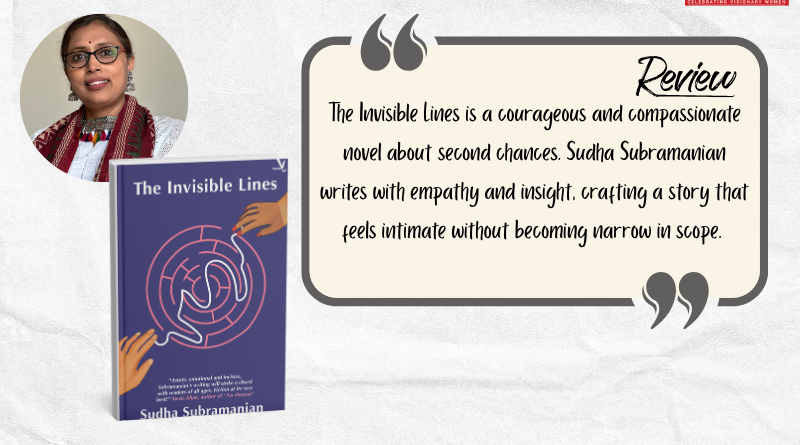
Sudha Subramanian’s The Invisible Lines (Vishwakarma Publications, 2026) is a deeply introspective exploration of desire, regret, loneliness, and the courage it takes to reclaim one’s life when society assumes that the time for reinvention has already passed. Tender yet unsettling, elegant yet emotionally raw, the novel dismantles conventional narratives around ageing, femininity, and romantic fulfilment with remarkable sensitivity.
At the centre of the story is Shashi, a woman approaching sixty, carrying the emotional residue of a failed marriage and years of silent compromise. Her life appears settled on the surface, shaped by routine and resignation, until an unexpected encounter with a sexagenarian paediatrician awakens emotions she had long buried beneath the weight of social expectations and personal disappointment. What follows is not a dramatic romance in the conventional sense, but a subtle and psychologically layered journey toward self-recognition.

One of the novel’s greatest strengths lies in its refusal to romanticise late-life love. Subramanian does not present Shashi’s emotional awakening as an easy escape from loneliness. Instead, she carefully examines the invisible emotional boundaries that determine how women are expected to age. The title itself becomes profoundly symbolic. These invisible lines are everywhere between duty and desire, companionship and independence, secrecy and truth, societal respectability and personal happiness. Shashi emerges as a compelling protagonist precisely because she is imperfectly human. She is hesitant, conflicted, vulnerable, and at times painfully self-aware. Her inner world is rendered with striking authenticity. The reader feels the ache of lost years, the hesitation before emotional risk, and the desperation of someone who realises time is no longer infinite. The urgency that pulses beneath the narrative gives the novel emotional momentum without resorting to melodrama.
Subramanian’s prose is restrained and thoughtful, allowing emotion to simmer beneath ordinary interactions. The narrative style mirrors the reflective, measured, and turbulent emotional landscape of the protagonist. There are moments where silence speaks louder than dialogue, where pauses and memories carry more emotional weight than overt declarations. This subtlety is one of the book’s most admirable literary qualities. Rather than overwhelming the reader with sentimentality, the novel trusts emotional intelligence and lived experience.
The relationship between Shashi and the paediatrician is handled with maturity and nuance. Their connection is by recognition. Two people meeting at a stage in life where companionship acquires a different meaning. There is tenderness in their interactions, but also fear, hesitation, and the looming presence of unresolved histories. The dark secret alluded to in the premise adds emotional tension to the narrative and complicates the possibility of happiness, reminding readers that the past never entirely loosens its grip. Importantly, The Invisible Lines challenges the cultural invisibility often imposed upon older women. Literature and cinema frequently reserve stories of passion, transformation, and emotional risk for the young. Subramanian pushes firmly against this limitation. Shashi’s desires are treated with dignity. In doing so, the novel opens space for conversations about ageing and emotional fulfilment that are still considered uncomfortable in many societies.
Another striking aspect of the novel is its exploration of time. Time in The Invisible Lines is emotional. The narrative repeatedly returns to questions of what was lost, postponed, denied, or endured. Shashi’s reflections carry the bittersweet awareness that entire decades can disappear beneath obligation. Yet the novel never becomes cynical. Instead, it suggests that emotional rebirth remains possible, even after years of silence and self-suppression. The supporting characters also contribute meaningfully to the emotional texture of the story. Whether through judgment, concern, affection, or misunderstanding, they represent the social pressures surrounding Shashi’s choices. These interactions highlight how deeply personal decisions become public negotiations, especially for women navigating love later in life.
If there is one criticism to be made, it is that the novel occasionally lingers too long in introspection, slowing the narrative pace in certain sections. However, even these moments serve a purpose. The emotional stillness reflects Shashi’s own internal paralysis, making the eventual movement toward self-determination more meaningful. Ultimately, The Invisible Lines is a courageous and compassionate novel about second chances. Sudha Subramanian writes with empathy and insight, crafting a story that feels intimate without becoming narrow in scope. The novel speaks to anyone who has ever wondered whether it is too late to begin again, to choose differently, or to reclaim parts of themselves left behind in the pursuit of survival.
In a literary landscape crowded with predictable romances, The Invisible Lines distinguishes itself through emotional maturity and thematic depth. It reminds readers that desire does not disappear with age, that healing is rarely linear, and that happiness often demands difficult acts of honesty. Most importantly, it affirms that the human heart remains capable of transformation at any stage of life.
A poignant, reflective, and radical novel, The Invisible Lines leaves behind the lingering question that defines all meaningful literature: What invisible lines continue to govern our lives, and what might happen if we finally dared to cross them?
About the Book
An Autumn Love Story – Shashi was married once, but an unexpected encounter with a sexagenarian paediatrician, reignites all her suppressed desires. If the invisible lines are leading her on a path to the ubiquitous “happily ever after”, Shashi has to stand up to the challenge, face the dark secret. She has to seize the moment, write her destiny because she will soon turn sixty and she cannot waste any more time.