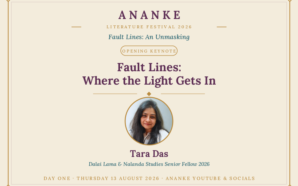


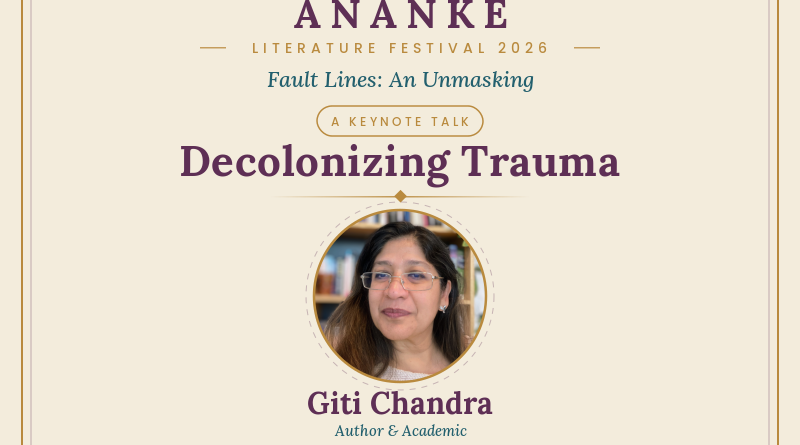
The Ananke Literature Festival 2026 will host Decolonizing Trauma, a keynote talk by academic and author Giti Chandra, Associate Research Professor with the Gender Equality Studies and Training Programme (GEST) in Reykjavik. The session airs at the festival’s seventh edition, August 13–15, 2026, on Ananke’s YouTube channel and across its social media platforms.
Held fully online under the theme Fault Lines: An Unmasking, this year’s festival examines the visible and invisible fractures that shape lives across nations, communities and the self. Few of those fractures run deeper, or are more carefully unseen, than the ones colonialism left behind — and few are so rarely named as trauma at all.
About the Session
Colonialism was not an episode. It was a planetary system, sustained across centuries and continents, and its violence did not end with the lowering of flags. In this keynote, Giti Chandra traces that global scale and its long afterlife — in institutions, in archives, in the stories a culture is permitted to tell about itself.
Her argument turns to the field of trauma studies itself. Some historical traumas have been given language, memorials, curricula, research funding and a vocabulary of witness; others, no less catastrophic, have been left without any of it. That disparity is not accidental, and Chandra makes the case that trauma studies must be decolonised if it is to account honestly for what the majority of the world has lived through.
Along the way the talk considers how colonial regimes worked to erase the evidence of their own violence and what it means to research a history whose archive was engineered to be incomplete. It is a conversation about disrupting settled narratives, about the generations now refusing to inherit them quietly, and about the exhaustion and the hope that come with that work.
About the Speaker
Giti Chandra is currently Associate Research Professor with the Gender Equality Studies and Training Programme (under the auspices of UNESCO) in Reykjavik; she also teaches at the University of Iceland, and has been Associate Professor in the Department of English at St. Stephen’s College, Delhi. Dr. Chandra did her doctoral work at Rutgers University, New Jersey.
She is the author of Narrating Violence, Constructing Collective Identities: To witness these wrongs unspeakable (2009), and co-editor of The Routledge Handbook on The Politics of the #MeToo Movement (2021), Decolonising Feminisms: Transnational Perspectives (2025), and Pedagogies of Reckoning: Colonialism and Nordic Education (2027). She is the recipient of an EDDA grant for a book-length study titled In Visible Texts: Hidden and Spectacularised Violence in Colonial India and Africa.
A Word from Ananke
“Trauma has a hierarchy, and that hierarchy was built — some histories are given language and memorials, others are left to be carried privately, without a vocabulary to name them. Giti Chandra asks us to notice who decided that, and why. It is exactly the kind of fault line this festival exists to unmask,” said the organisers of the Ananke Literature Festival.
About the Ananke Literature Festival
Launched in 2020 by Ananke (www.anankemag.com) — a digital media and development platform focused on technology, diversity, innovation, media and literature across the Global South — the Ananke Literature Festival is a fully online event celebrated for creating meaningful conversations about the written word, publishing, diversity, empowerment and social justice. Its seventh edition, themed Fault Lines: An Unmasking, airs August 13–15, 2026, with pre-recorded sessions broadcast on Ananke’s YouTube channel and across its social media platforms. Past speakers include Urvashi Butalia, Naveen Kishore, Feryal Ali Gauhar, Mohammad Hanif, Meena Kandasamy, and many more.