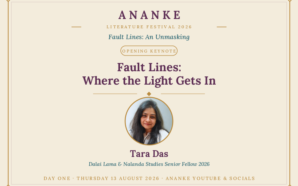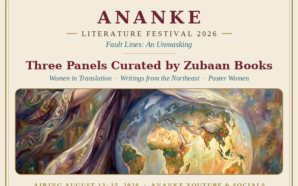


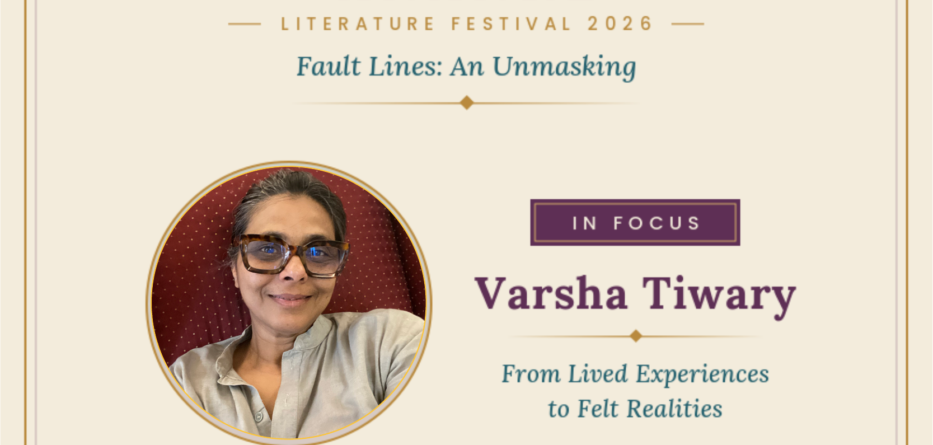
What does resistance mean in a world with a climate of hate and fear? For many, humanity is resilience, and speaking truth—not just to power—is subversion. Talking about language as resistance, Ananke Literature Festival’s guest speaker Varsha Tiwary shares her thoughts—a teaser leading up to the main digital event happening in August.
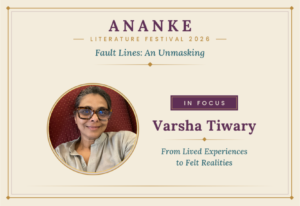
Varsha Tiwary is a Delhi-based writer and translator. She recently published 1990, Aramganj, a translation of the bestselling Hindi novel Rambhakt Rangbaz by Rakesh Kayasth and Laffaz, a translation of Yogendra Ahuja’s novella by the same name. She is also a recipient of the HWR Emerging Writers Fellowship, 2025.She is currently working on a fiction project.
 What does the theme Language as Resistance: Translating Stories Beyond Dominant Narratives mean to me.
In a world, where forces much-much larger than our puny selves, have a stake in the multi-crore enterprise of building reality-shaping narratives; the one act of resistance left to the individual, is of never letting go of the right and the duty of connecting the zig-zag line from lived experience to felt reality. By writing, translation and by reading diverse literature.
This is one revolution all of us can participate in, from the comfort of our bedrooms. I will talk about this by sharing my experience of taking a deep dive into the ocean of Hindi literature.
In your view, why are conversations around literature, culture, media, and social justice especially important today?
Arundhati Roy says, ‘Nothing releases truth like language.’ And hence literature, the art of wielding language so that the truth is set free and delivered to the reader with all the force of personal experience, matters.
When those in power speak as if words bear no connection to reality, emptying out meaning from words, when nonsense is elevated to high wisdom, deploying language in indirect, roundabout, silent but loud ways so that truth is delivered to the reader in all his subjectivity becomes an act of resistance.
Apart from demagoguery, we are also seeing AI LLMs (Large Language Models) which view language as a product and monetise it, take over our ability to think and articulate.
LLM’s threaten to convert humanity into zombies happy to outsource all cognitive labour to an AI assistant
AI is dangerous because it dangles before us the convenience of not thinking. Of dispensing with the effort of writing messy sentences (to me, writing and thinking are synonymous). Today we need to protect our imagination and perception, the two things that enable us to articulate our lived reality.
What are you currently working on or thinking deeply about?
I am working on my novel about growing up and around a mother who easily disintegrated and who, with age, fell apart more and more. As I write in English, the gap between the tongue and the mind is always visible and irksome. The experience is always more vivid, more concrete, more specific as it is in mother tongue. So while writing in English I am constantly conscious that I must write in ways charged with meaning. I am grateful that translating from Hindi has given me the ability to commute between languages and enriched my English writing.
Check out Varsha Tiwary’s page or click on the links below for more information about her works.