

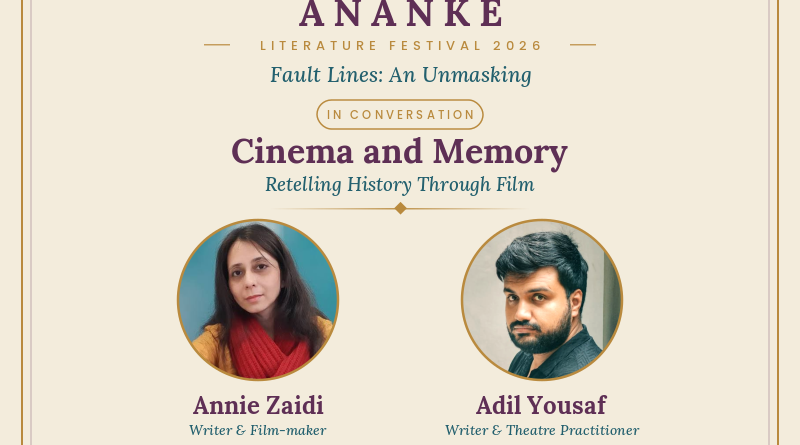
The Ananke Literature Festival 2026 will host Cinema and Memory: Retelling History Through Film, a conversation between writer and film-maker Annie Zaidi and writer and theatre practitioner Adil Yousaf, hosted by Ananke’s Founder and Executive Editor, Sabin Muzaffar. The session airs at the festival’s seventh edition, August 13–15, 2026, on Ananke’s YouTube channel and across its social media platforms.
Held fully online under the theme Fault Lines: An Unmasking, this year’s festival examines the visible and invisible fractures that shape lives across nations, communities and the self. Cinema sits directly on one of them: the line between what happened and what we remember happening.
About the Session
Films revisit historical events with a force that textbooks rarely manage. A close-up, a score, a sweeping montage — cinema does not simply present the past, it makes the past feel present, and it triggers empathy before it invites scrutiny. Over time the source fades and the story remains: the film’s version quietly becomes the remembered one.
Annie Zaidi and Adil Yousaf take up that slippage from either side of a border, drawing on Indian and Pakistani cinema and on their own formative relationships with the screen. The conversation moves between two questions: whether a film-maker owes their audience empirical accuracy or a deeper emotional truth, and how far a historical film is really about its own moment — the past recreated as commentary on the present, a setting distant enough to say what the present cannot.
It closes on the hardest question of all: in deeply divided societies, can a film about past conflict genuinely heal a wound, or does it risk reopening one?
About the Speakers
Annie Zaidi is an award-winning Indian writer, journalist, and holds a pHD from Durham University focusing on the depiction of ‘witches’ in contemporary South Asian literature. Across fiction, non-fiction, drama, and film, her widely acclaimed works include Prelude to a Riot (winner of the 2020 Tata Literature Live Award), Bread, Cement, Cactus (winner of the 2019 Nine Dots Prize). Her novella, The Comeback is a restrained yet incisive exploration of friendship, betrayal, artistic integrity, and the elusive nature of success. A former journalist published in global outlets like The Hindu, Caravan, and Wasafiri, she has also won The Hindu Playwright Award and directed the documentary In Her Words: The Journey of Indian Women.
Adil Yousaf is a lecturer in International Relations, theatre practitioner, and Urdu storyteller based in Pakistan. His interests lie at the intersection of cinema, politics, memory, and literature, particularly in how stories shape identities and collective memory. He also conducts workshops on Urdu language and poetry.
About the Host
Sabin Muzaffar is the Founder and Executive Editor of Ananke and leads the Ananke Literature Festival. With over 20 years of experience across print and digital media, she writes and speaks on gender, technology and media across the Global South.
A Word from Ananke
“We tend to think of memory as something we hold and film as something we watch. This session turns that around: cinema has been doing our remembering for us, across a border and on both sides of it. Asking whose version we inherited, and who chose it, is exactly the kind of unmasking this festival is for,” said the organisers of the Ananke Literature Festival.
About the Ananke Literature Festival
Launched in 2020 by Ananke (www.anankemag.com) — a digital media and development platform focused on technology, diversity, innovation, media and literature across the Global South — the Ananke Literature Festival is a fully online event celebrated for creating meaningful conversations about the written word, publishing, diversity, empowerment and social justice. Its seventh edition, themed Fault Lines: An Unmasking, airs August 13–15, 2026, with pre-recorded sessions broadcast on Ananke’s YouTube channel and across its social media platforms. Past speakers include Urvashi Butalia, Naveen Kishore, Feryal Ali Gauhar, Mohammad Hanif, Meena Kandasamy, and many more.