

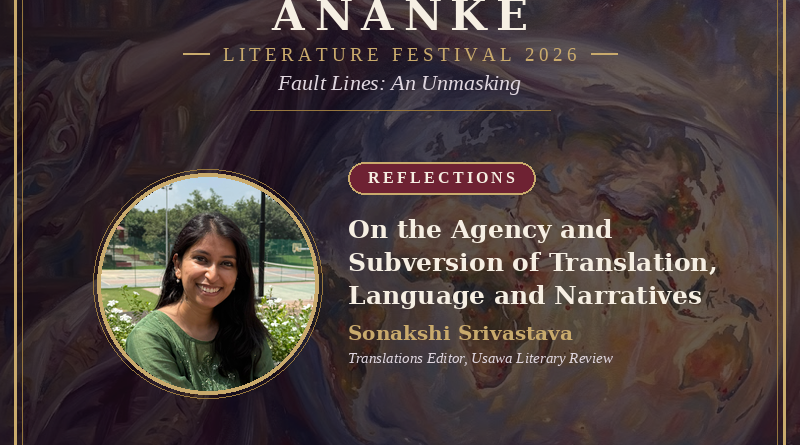
Sonakshi Srivastava is a senior writing fellow (ELT) at Ashoka University, the translations editor at Usawa Literary Review, and an educational arm assistant at Asymptote. Her writings have generously been supported by the PEN English x SALT Translation Grant, 2024 ASLE Translation Grant, Poetry HUES Foundation, Director’s Fellowship (Martha’s Vineyards Institute of Creative Writing), Diverse Voices Fellowship, and the Alkazi Foundation for the Arts. Her words may be found at Tendon Magazine, fingerfood mag, WritingWomen, Usawa Literary Review, The Locavore, The Alipore Post, ASAP/Art, The Bilingual Window, Potluck Zine, Hakara, etc. She is a former translation fellow with the South Asia Speaks programme.
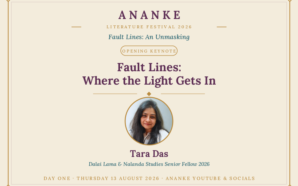
Sonakshi will be part of the Language as Resistance: Translating Stories Beyond Dominant Narratives session at Ananke’s Literature Festival 2026. Watch it in August on Ananke’s YouTube Page.
- What are you currently working on or thinking deeply about?
I find myself moving between two translation projects that I am working on, and which on the surface, share little. And yet each keeps returning me to the same fault line: what survives the crossing between languages, and what is lost precisely because it was never meant to travel? I think of this loss the way I have come to think of waste, as a discard studies scholar — not as a useless remainder but as excess and surplus, something that leaks across borders and quietly haunts the text it was excised from. It has made me think of translation less as a bridge and more as a kind of soil — something that holds memory, decay, and regrowth all at once. What I’m sitting with most is the ethics of that holding: whose labour gets called “translation” and whose gets called “inspiration,” and what it means to translate not just words but entire cosmologies of knowing. It is, I suppose, my own way of resisting disenchantment — of refusing to let the attention economy blunt the many whys a text still owes me.
- What do you hope audiences take away from this year’s festival conversations?
I hope audiences leave attentive to the fault lines that don’t announce themselves — not the dramatic ruptures, but the quiet, administrative ones. I would like audiences to leave suspicious of any story, including their own, that claims to have no fragments — and curious enough, still capable of asking why, to go looking for them anyway.
- What role do writers, artists, journalists, and thinkers play in challenging dominant narratives?
I think the task is not only to challenge dominant narratives head-on but to sit inside the fault line itself — in the space between the private self and its public performance. There is an emotional arithmetic that writers and translators are custodians of: the untold histories, the silences that get filed under resilience instead of named as rupture. Unmasking is not always a dramatic reveal; often it is a slow, patient counter-administration — restoring what was filed away, one sentence, one silence, at a time. That is the unmasking I would claim for the writing world— not exposing a hidden truth so much as refusing the fiction that a word, or a nation, was ever meant to arrive at wholeness without first passing through its own fractures.
Recent published works