


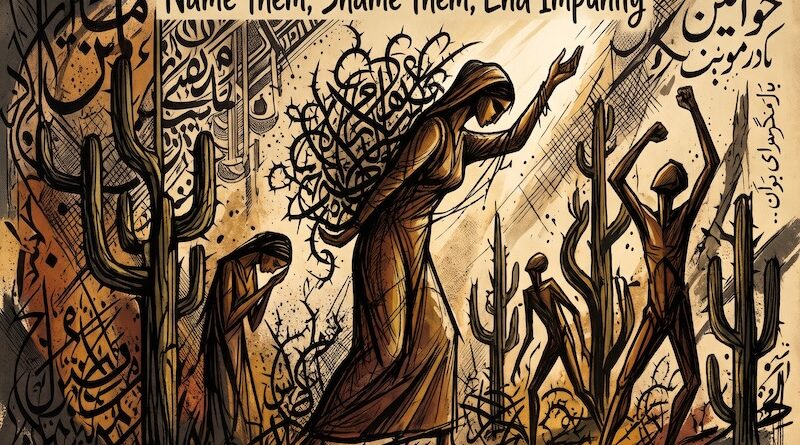
We are the wretched of the earth, carrying baggage – not entirely of our own doing. Heaped upon us. It is luggage – backbreaking and heavy! Loaded with contempt, piles of violence, and layer upon layer of shame. Unravelling and undoing fall upon us to unburden… to break free.
Today, as we have done for decades, we commemorate the International Day for the Elimination of Violence Against Women, also kicking off 16 Days of Activism and concluding on December 10th with Human Rights Day. Each year,commentary, opinions, and statistics are amassed – how many women are killed, one way or the other; child brides starting their lives as married women coerced to act like adults; many murdered on eventful days like the Super Bowl; and then there are many of us who die a very slow death due to the ‘shame’ we have supposedly brought upon our families.
Data is indeed important. It is used for evidence creation, which in turn helps in legal, regulatory, and budgetary processes when it comes to non-profits, governments, and bilateral and multilateral agencies. The scope is wider, with the potential of enabling sustainable actions.
More laws have been created, indeed, especially after the Beijing Platform for Action in 1995 and since the Sustainable Development Goals in 2015. Governments have worked and expanded their legal and institutional frameworks. A single question to ChatGPT or Gemini will attest to that. Many resources, including the UN Women Data Hub, show that governments across 191 countries have enacted laws outlawing domestic violence, and there are clear indications of more than 90 percent of national measures in place that focus on addressing technology-facilitated violence. More than 10,000 policy and programmatic measures across 194 countries and territories have been established and are being tracked by UN Women’s Global Database, facilitating even more visibility.
What this information then goes on to show is that actionable results on the ground have either stalled or even regressed.“Africa remains the continent with the highest rate of victims of intimate partner/family member femicide (2.9 victims per 100,000 female population), followed by the Americas (1.4 victims), Oceania (1.1 victims), Asia (0.6 victims), and Europe (0.5 victims).” – UN Women.
“Forty-seven thousand women and girls were killed intentionally during 2025 by an intimate partner or family member; sixty per cent of the 78,000 total femicides in 2025 were committed by an intimate partner or family member – an average of five women every hour, or 129 per day.”
Reams of paper have been blackened – proverbially and otherwise – with frameworks and actionable inactions. It is all there, yet what remains is neither an uptick nor steady progress when it comes to what is happening on the ground.
Do women really know how the legal frameworks and policies work? Let’s start with a few examples from, say, our Facebook backyard. A friend who works in the health-tech sector posted some time ago about how surprised she was upon finding out there are appropriate measures that can be taken against digital violence. As privileged as she is, little did she know how the legal system worked and how to approach it.
Yet another friend relayed how women and girls had been snared into traps digitally, and she, along with the local police,had not just counselled many, but had also apprehended the blackmailer with the victims’ help.
Yes, there are instances such as these. But they are few and sparse when one looks at the bigger picture.
Memories are still fresh of a victim murdered decades ago by her own brother. I will name her because she was young and beautiful, so full of life, so full of love: Mahnaz. She was as radiant and filled with grace as the moon… as her name suggests.
I say her name because she is not just a number!
There is no charge, let alone any allegation, that allows one to be murdered in cold blood.
But I will name the perpetrator – Asif.
I call out his name because we have yet to enumerate him as a number!
But it is not Asif alone.
It is the idea of shame that instigates the perpetrator. The notion of honor hegemonized through vile machismo. What more does an ignoble, illiterate, ignorant man know of honor than a woman with the weight of the world upon her shoulders?
The onus of shame is on women; the brunt of honor is on women.
Where are all the men? Where are all the numbers?
Actionable actions point in one direction: Name Them, Shame Them, End Impunity.
Info about the image: AI-generated photo