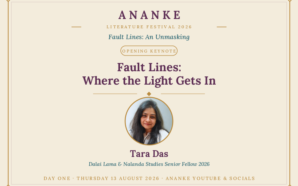


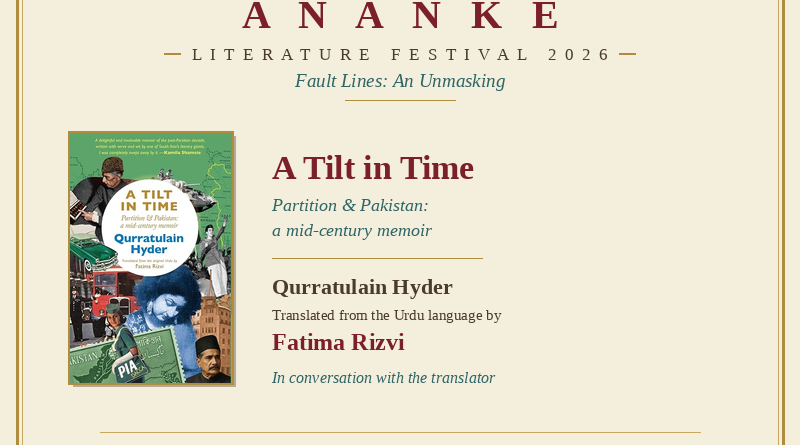
Dubai, UAE — The Ananke Literature Festival 2026 will host a session on A Tilt in Time — Partition and Pakistan: A Mid-Century Memoir, the newly released translation of Qurratulain Hyder’s Kar-e Jahan Daraz Hai (Women Unlimited, 2026), in conversation with its translator, Professor Fatima Rizvi. The session airs at the festival’s seventh edition, August 13–15, 2026, on Ananke’s YouTube channel and across its social media platforms.
Held fully online under the theme Fault Lines: An Unmasking, this year’s festival examines the visible and invisible fractures that shape lives across nations, communities and the self. Few works sit more squarely within that inquiry than Hyder’s memoir of the years following Partition — a book that maps, in intimate and unsparing detail, the fault line of 1947 and the making of a new nation. That this conversation airs in August, the month Pakistan commemorates its independence, gives it a particular resonance: it turns from the iconography of nationhood to the lived, uneven, deeply human experience of a country in its formative decade.
About the Session
Drawn from Parts 12–15 of Hyder’s monumental Kar-e Jahan Daraz Hai, A Tilt in Time recounts a restless, formative decade shaped by Partition and its aftermath, moving between Delhi, Lahore, Karachi, Dhaka and London. Hyder described the sweeping work as a “biographical non-fiction novel” — an intimate social history of Pakistan in the 1950s, before the advent of martial law, told with her characteristic wit and wry observation. Writer, observer and traveller, Hyder stands at the centre of her own story, at once witness and participant, as memory folds into narrative and the personal and political become inseparable. What emerges is a profound meditation on belonging — on the impossibility, yet the necessity, of return.
In conversation, Fatima Rizvi opens up the labour and the intimacy of carrying such a work across languages: the challenge of rendering Hyder’s layered Urdu prose, her irony and her allusive range, for a new readership without flattening it. The session considers translation itself as an act of unmasking — a way of making visible histories, voices and interior worlds that too often go unheard beyond their own geographies — and asks what it means to return, through language, to a moment when a nation and its people were still being imagined.
About the Book
A Tilt in Time — Partition and Pakistan: A Mid-Century Memoir (Women Unlimited, 2026) is Fatima Rizvi’s translation of excerpts from Qurratulain Hyder’s Kar-e Jahan Daraz Hai. It offers a unique, intimate social history of Pakistan in the 1950s, peppered with Hyder’s wit and wry observations, and stands as a meditation on migration, work and the shifting cultural worlds of mid-century South Asia. The books is published by Women Unlimited Ink and is available here.
About the Author
Qurratulain Hyder is among the preeminent writers of Urdu in India. Her published work consists of four collections of short stories; five novels, including the classics River of Fire and Fireflies in the Mist; and several novellas. She was a journalist, scriptwriter, editor with The Illustrated Weekly of India, and broadcaster with the BBC, as well as Producer Emeritus, All India Radio. Among her many honours are the Padma Shri, the Sahitya Akademi Award, the Bharatiya Jnanpith and the Padma Bhushan.
About the Translator
Fatima Rizvi is Professor in the Department of English and Modern European Languages, University of Lucknow, India. Her areas of academic interest include colonial and postcolonial studies, translation, Urdu and film studies, and she has been published in journals of national and international repute and in anthologies of criticism. She co-edited Understanding Disability: Interdisciplinary Critical Approaches (Springer Nature, 2023) and is editing Revisiting the All-India Progressive Writers’ Movement: Critical Perspectives on Literature and Culture for Oxford University Press. Her translations of Qurratulain Hyder include Beyond the Stars and Other Stories (Women Unlimited, 2021) and A Tilt in Time — Partition and Pakistan: A Mid-Century Memoir (Women Unlimited, 2026); she also co-translated At Home in India: Stories, Memoirs, Portraits, Interviews (Women Unlimited, 2024), and translated Javed Siddiqi’s essays as Shadows on the Wall: Pen-portraits (Om Books International, 2026). She is a Meenakshi Mukherjee Memorial Prize (2018) and a Jawad Memorial Prize (2019) awardee.
A Word from Ananke
“Translation is one of the truest forms of unmasking — it lifts a work out of silence and carries its histories into another language and another readership. To host this conversation in August, as Pakistan commemorates its independence, and to turn to Hyder’s mid-century memoir through Fatima Rizvi’s remarkable translation, feels especially fitting: it lets us look past the iconography of nationhood to the human story beneath it,” said the organisers of the Ananke Literature Festival.
About the Ananke Literature Festival
Launched in 2020 by Ananke (www.anankemag.com) — a digital media and development platform focused on technology, diversity, innovation, media and literature across the Global South — the Ananke Literature Festival is a fully online event celebrated for creating meaningful conversations about the written word, publishing, diversity, empowerment and social justice. Its seventh edition, themed Fault Lines: An Unmasking, airs August 13–15, 2026, with pre-recorded sessions broadcast on Ananke’s YouTube channel and across its social media platforms. Past speakers include Urvashi Butalia, Naveen Kishore, Feryal Ali Gauhar, Mohammad Hanif, Meena Kandasamy, and many more.