

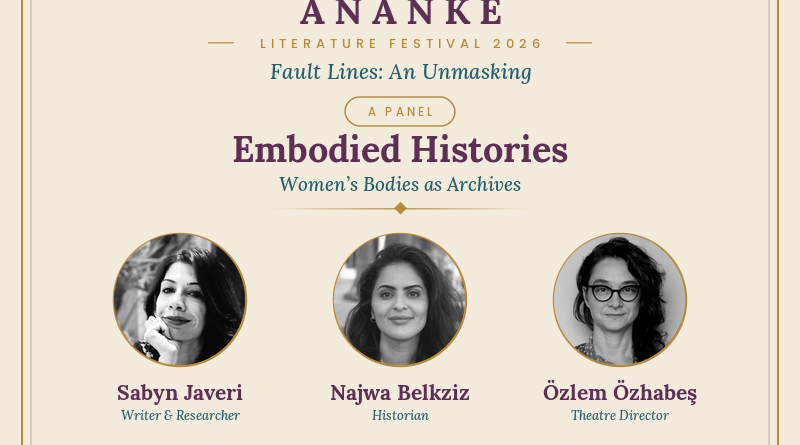
The Ananke Literature Festival 2026 will host Embodied Histories: Women’s Bodies as Archives, a panel bringing together writer and practice-based researcher Sabyn Javeri, historian Najwa Belkziz, and theatre director Özlem Özhabeş. The session airs at the festival’s seventh edition, August 13–15, 2026, on Ananke’s YouTube channel and across its social media platforms.
Held fully online under the theme Fault Lines: An Unmasking, this year’s festival examines the visible and invisible fractures that shape lives across nations, communities and the self. This panel finds one of the deepest: the gap between what the archive recorded and what women’s bodies have carried instead.
About the Session
What does it mean to decolonize history? While conversations about decolonization often focus on museums, institutions, and historical records, women have been doing this work for generations. Their bodies have carried histories that colonial archives ignored, erased, or dismissed.
In this panel, a writer, a historian, and a theatre practitioner — three women working across disciplines — explore decolonization not as theory, but as embodied practice. Through the traditions of henna, Mesopotamian tattooing, and Moroccan public bathing and cleansing rituals, they trace histories carried through the body: histories preserved in ritual, adornment, touch, and collective care rather than in written archives.
Together, these practices reveal the body as a living archive, challenging us to rethink where history lives, who preserves it, and how it is passed on across generations.
About the Panellists
Sabyn Javeri is a writer, translator, and practice-based researcher whose work examines henna, embodiment, and women’s aesthetic labour as forms of cultural memory. Drawing on her background in multilingual storytelling, feminist literary studies, and her long engagement with yoga as an embodied philosophy, she investigates how ritual, touch, and artistic practice operate as living archives across South Asia, the Gulf, and the South Asian diaspora in the UK. Her research brings together ethnography, visual experimentation, and translation to illuminate the sensory, somatic, and intimate dimensions of women’s histories. She teaches at NYU Abu Dhabi and at the University of Oxford.
Najwa Belkziz is a historian whose work examines how women and marginalised communities across North Africa and Southeast Asia remember, narrate, and contest the past in everyday life. Her research focuses on the tension between state-curated histories and vernacular memory practices, particularly in contexts of migration, reform, and political transformation. Combining archival research with oral history and sensory ethnography, she investigates how ritual, care, and embodiment operate as modes of historical knowledge beyond institutional record.
Özlem Özhabeş is a theatre director, performer, and lecturer whose work explores the layered textures of stories, peeling back language, image, and gesture to uncover hidden power structures and unspoken truths. With a passion for devising, reimagining classics, and cross-cultural storytelling, she has been developing her directing practice through diverse projects in Istanbul, London, Florence, and Abu Dhabi. Her research-driven practice engages themes of voice, body, memory, and feminist dramaturgy.
A Word from Ananke
“An archive is a decision about what deserves keeping, and women have rarely been the ones making it. What this panel shows is that the record survived anyway — in henna, in ink, in the rituals of the bathhouse, passed hand to hand instead of catalogued. Asking where history actually lives is exactly the kind of unmasking this festival exists for,” said the organisers of the Ananke Literature Festival.
About the Ananke Literature Festival
Launched in 2020 by Ananke (www.anankemag.com) — a digital media and development platform focused on technology, diversity, innovation, media and literature across the Global South — the Ananke Literature Festival is a fully online event celebrated for creating meaningful conversations about the written word, publishing, diversity, empowerment and social justice. Its seventh edition, themed Fault Lines: An Unmasking, airs August 13–15, 2026, with pre-recorded sessions broadcast on Ananke’s YouTube channel and across its social media platforms. Past speakers include Urvashi Butalia, Naveen Kishore, Feryal Ali Gauhar, Mohammad Hanif, Meena Kandasamy, and many more.