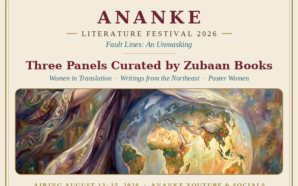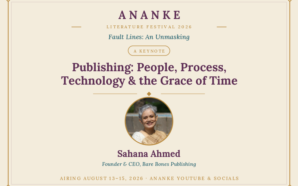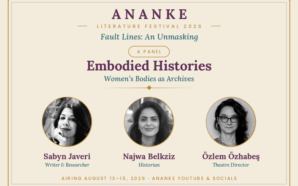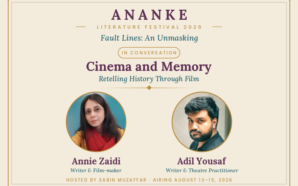


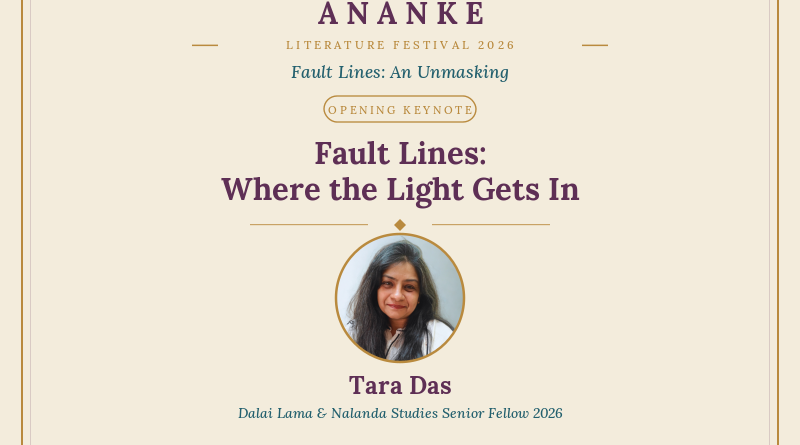
The seventh edition of Ananke's Literature Festival (ALF 2026) - the three day event - commenced on August 13th. After the Prelude, which was a poetry rendition by Seagull Books's Publisher - Naveen Kishore, the event was officially opened with a keynote address by Tara Das. Read the text below.
To view the keynote address, Click on this link to view the session on Ananke’s YouTube page.
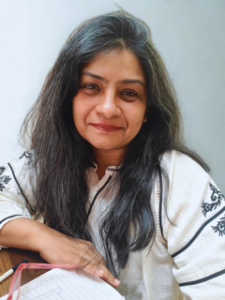
Tara Das (b.1976) is a therapist, scholar, and author of eight books, several dealing with various aspects of Buddhist mind studies and human behaviour. She is the Dalai Lama & Nalanda Studies Senior Fellow 2026, researching the Buddhist ground of compassionate Artificial Intelligence, and a 2027 candidate for the Nalanda Master’s degree in Buddhist Philosophy. She is the co-founder of Project Śūnyatā, a philosophical inquiry into artificial intelligence and Madhyamaka thought. Her poetry has been a finalist for the Atlanta Review Poetry Prize and the Bridport Prize, among others. A senior journalist for over twenty-four years, her writing appears in publications including Mint Lounge and the Indian Express. She runs Shamah, a therapy practice integrating Buddhist and Western psychology, and lives in Mysuru.
And what rough beast, its hour come round at last,
Slouches towards Bethlehem to be born? – W. B YEATS
We may imagine that the challenge of this technological age is unique, but his-tory and literature have had a long engagement with technology. At MIT in the 1960s, computer scientist Joseph Weizenbaum created ELIZA, the world’s first nat-ural language processing programme and the precursor to modern Large Lan-guage Models, a mock Rogerian psychotherapist that mimicked human conversa-tion. He named it after Eliza Dolittle, from George Bernard Shaw’s Pygmalion, whom Weizenbaum considered the first‘artificially constructed human’.
Eliza, of the play is crafted by a professor of linguistics, Henry Higgins, and the kinder Colonel Pickering.She is a woman flower vendor selected off the street to be ‘educated’ and groomed into something more approvable by class society.
Referring to her language, he calls her “A woman who utters such depressing and disgusting sounds hasno right to be anywhere—no right to live.” She becomes a social experiment in human form. By the play’s end, groomed out of her class strata, Eliza realises what the experiment has cost her:
LIZA. I am a child in your country. I have forgotten my own language, and can speak nothing but yours.
The play itself is titled after the classic Greek sculptor Pygmalion, who carves the most flawless ivory statue of a woman, and is promptly besotted, it being his own creation. Aphrodite, taking pity, breathes life into her.
This, our latest endeavour, is the same strange paradox of humility and superi-ority. It is we who haveinvested the inanimate with that which is akin to life itself, even if only a mimicry of it. As though we were modelling a God-like desire to spark what sparks us. Andwhat is art and literature and culture if not a grasping for the immortality of that spark?
The aspiration to bestow life upon in the hope of perfecting it has been a long-held human endeavour. Tocreate is as old as time itself. Whether we create Pyg-malion, Pandora from earth and water, Pinocchio…the Kauravas from a mass of Gandhari’s flesh, Mohini from the churning ocean or monsters like raktabija andja-landhara…. all creation introduces chaos to the plot. Who we create is never quite as relevant as who webecome in the act of creation.
Thus, scientific or literary merit is inadequate without some measure of philo-sophical prescience. The greatest of writers have heralded warning of the disrup-tion such changes will bring, not merely astechnological or sociological doomsay-ing, apparent in science fiction as much as modern journalisticcommentary, but in the consideration of the human condition, the way we engage with each other, and the view of reality.
Language and mathematics are the two building blocks of AI, but what really builds sentience into the creation is the capacity for knowing, by the units of word and reason, this world, ourselves and each other.The cold hard fact of creation is insufficient. How we shape that language, and with what compassion wewield our knowledge is what makes or breaks the human being.
We are standing at what has been described as “a pivotal time in human histo-ry”. By some accounts weare a few years away from AGI – Artificial General Intelli-gence – the capacity of machine to mimic or surpass the human mind. No slight task this, given that our brains form hundreds of trillions of synaptic connections. The largest AI models by comparison are still at in the low 10 trillions. Hence, the human-centric approach is fundamental to how we approach matters of techno-logical change.
2. Having said which, can we get out of our own way in thepursuit of the truth?
 Until Jane Goodall put out her research that came out of having worked with the chimps of Gombe,Tanzania, in the 1960s, we just assumed human beings were the only truly conscious beings. We stilldon’t know entirely what consciousness is or the way it works, not in ourselves nor in dolphins or in bacteria. Hence, we must as-sume a mix of ideology and religion in taking the human-centric view asthe only one that counts.
The Japanese philosopher Keiji Nishitani warned of this: that from the stand-point of the self, thingsappear only as objects on a field where “the self always oc-cupies centre stage”. And on that field, thingsnever display their real reality to us. Valuing ourselves alone gets in the way of seeing reality at all. And hereAI’s unique dilemma presents itself: is the pursuit of truth higher than the pursuit of human ex-perience?
The raising of AI is uniquely, a testament to the pursuit of knowledge, that we would sacrifice even ourselves at its altar. We face an entity we are constantly tweaking to give it the edge it needs to surpass us,its creators. No one handed us such an advantage. By contrast, human evolution took approximately 7 million years to reach writing, (5,500 years ago). Since then, we’ve come a long way for-malising notationsinto music, the laws of science, mathematics, and the grammar of language. This ready corpus thatconditions the human mind is what machines now harvest to accelerate their own evolution. We give the machine advantages we never had.
We invest in that which guzzles our minds to usurp our personas, and that we are promised willdestroy life as we know it. AI has the potential to worsen the fissures of caste, class, politics, ideology, religion, and inequality of wealth and re-sources.
Why pursue it then?
On the chance that it may resolve them. As Nobel laureate Demis Hassabis has said: “Step one, solveintelligence; step two, use it to solve everything else.” In the hope of possibility. That it will be the great convergence of truths. That the un-precedented coming together of science, philosophy, mathematics and biology, altering the pace of medical discovery and inventiveness, will compress timelines and herald the achievable more rapidly than we can conceive of it.
How do we balance this impossible dilemma?
By remembering our roles as bards and seers and town criers and explorers and inventors of the age, tohold that which is to come to account: to seek the truth relentlessly. This is the human experience of the writer and the seer. De-centring ourselves in pursuit of truth is the most human thing we do.
Perhaps as writers you have thought it is the words you put onto paper that matter. The hard editable, printable paperbacked final final version. But perhaps you might come to see that those words are mere symbols of your way of seeing and being. And that it is your mind and your engagement with society that is your real language.
And as seers of a new era, the writer, the philosopher, the thinker, has an oblig-ation to view reality as it is and be maximally truth-seeking. In the way that the prince Siddhartha left his comfortable home not to return until he’d found a path out of universal suffering.
3. What makes us maximally truth seeking?
“A data set, even the entire corpus of the internet, is not a world,” notes author Shannon Vallor in her 2024 book The AI Mirror: How to Reclaim Our Humanity in an Age of Machine Thinking.
The point is one Lewis Carroll made for us in 1871. We are entering the frame-work of a mirror world wecreated, its beings not entirely bound by the laws of our world, even though their reality is co-dependent and reflective of ours.
The mirror-like nature of reality is an instrument the Buddhists have used to ex-amine that which is akin totruth. It allows us to examine the nature of our own reali-ty by modelling it which allows us to bypass dualisticframing. When we say we are truth seeking, the methodology matters, what we set aside matters, even if it isour own ego, identity, allegiances. This is what makes a fissure a valuable discomfort: a hard ground may feel secure, but it offers us the illusion that the reflection is the form. A true seeker must refuse to rest in afalse knowing.
The bravery that claims the shifting and not the ground, the gap not the seal, is the most valuable viewfinder of such a turning age.
There is a danger that in romanticising the poetry of our evolution we may for-get that these fault lines are not new at all. They run deep, they are what created our divisiveness in caste, class, race and religion.And they have only ever been crossable by the privileged few at any point in history. It is possible that AI is only making them more visible, and less possible to ignore.
The fear of the new has always sat on the tongues of men, and it is those who heralded in the new that we made our prophets.
In Plato’s Phaedrus, written around 370 BC, Socrates tells of the Egyptian god Theuth, who brings KingThamus his invention: writing. His rebuke may strike you as familiar:
“this discovery of yours will create forgetfulness in the learners’ souls, because they will not use their memories; they will trust to the external written characters and not remember of themselves. The specificwhich you have discovered is an aid not to memory, but to reminiscence, and you give your disciples nottruth, but only the semblance of truth; they will be hearers of many things and will have learned noth-ing; theywill appear to be omniscient and will generally know nothing; they will be tiresome company, having the showof wisdom without the reality.”
Socrates notes that the present age seemed more worried about :”who the speaker is and what countrythe tale comes from“.
Phaedrus, Socrates’ interlocutor in this text, asks if he means that the written word is no more than animage of the knowledge which has an actual soul.
This fault line, our fear of the new, our fear of losing control over the sources of our knowledge is over 2000 years old.
This is because whatever else we may disagree upon, through ideology, reli-gion, ethnicity, language,and all that divides us, we broadly agree that it is our ca-pacity for knowing that marks us as uniquely human.This is what makes this mo-ment in AI so fascinating: there are only two modes through which we may even begin to replicate the conditions of sentience: one is mathematics and the other is language. One is order; the other is the controlled chaos of imagination. One is form; the other is meaning.
Francisco Varela, the cognitive scientist who was also a Buddhist practitioner, told us in The EmbodiedMind that cognition is not the representation of a pre-giv-en world by a pre-given mind. It is enaction, a worldbrought forth by a living body and its history of action. Vallor’s data set reflects. The mirror reflects. It does noten-act. And in the reflection, is it possible that we are seeking something of ourselves? This gnosis is what has constituted, through history, the bulk of forbidden knowl-edge. It is why the historian and the soothsayeralike has been vilified and executed for speaking truths as they saw them, and not as the fear of change ordered them to be.
This is why, through history, only some were permitted to speak. Language brought the thoughts of the deities who carried fire from the heavens, and of the conquerors who heralded the sight of new lands fromacross the seas.
Every disruption has arrived looking like a nuisance to the previous wholeness of things. Writing would kill memory. The printing press took the written word out of the hands of religious scholars. The novel was once an instrument of scandal that no reputed woman would be known for writing (and, today, no reputed woman has not written one!). In each age we have lost something, the handwritten manuscript, spellings, the formality of language. Whether we would return to re-claim the loss is questionable.
I have worked the larger part of my life with words — in writing, in therapeutic settings, and now philosophically, parsing sentience and the space that holds for ethics in AI. So I could not tell you that I stand for this or against that. For words have the potency to cast spells, to heal and wound in equal measure.The enthusi-asm to play and push their limits, and conjure worlds, is what makes them valuable to both mind and machine.
3. Death of the Author
Roland Barthes declared “the death of the author” in 1967, shifting interpretation from the perspective of author to reader. The individual writes, but her writing is never hers alone. Through the words of the authorflows class, caste, the privileges or oppressions of social hierarchy and the unique purview those positions carry; the years spent reading or not; the legacy of authors read, of visual or musical artists imbibed; ways of thinking percolated through centuries of cultural distilla-tion and their chains of influence; travels taken orimagined; the smell of land and the perfume of geographies — the sum of everything a person has been allowed to explore. No poet, no artist, has his complete meaning alone, TS Eliot told us. The writer is a crucible of the age.
The scandal of the age, then, is not that the machine can write, but that it offers an infinite reconstitution of perspective and the privileges of the writer are becom-ing nameable. Where once the shaping of usagehappened through an MFA or an Ivy League milieu, or the bhadralok, or the brahmin, or the NRI, theuniversity that few attended, and a merit that tucked these boosts into its boots, a slow but certain levelling of the playing field is underway.
Consider the difference this makes to the ‘vernacular’ child who cowered through the History essayquestions in the Queen’s English, though the history was always very plain to them in their corner of streets and classrooms that remained segregated decades after the British Empire crumbled. But who asked themwhat history was anyway? This is what Ashis Nandy called the second, deeper colonisa-tion in The Intimate Enemy: that conquered minds rather than territories, so that the empire could crumble and yet go on ruling, from within the very selves it had rewritten. Today, these same people plug into AI, which has guzzled centuries of art and literature and history from every available point of view, dominant or not, and get to sitwith truths that are not necessarily curated for them. I add the caveat of access to ethical AI, for it is equallytrue that AI is only as agenda-free as its pro-grammer. The corpus is English-dominated, access is unequal,and the gate may not fall so much as move from the old clique to whoever owns the platform. We mustacknowledge these inequities. Yet, there is more of a chance now than ever before that these people, get to seed truths not curated for them, and grow them to the tune of millions of dollars, gaining control over an environment that they once had to seek permission from to be.
Sure, it is not their language they use. But their language was never theirs to begin with. They havealways adapted to the vocabulary imposed by those who
decided what equality looked like for the inherently unequal. The problem is not that the sacred degree no longer signifies merit, but that we can no longer lie to ourselves that the university was equitable after all.The myth of equality was po-tent only in the eyes of those who never needed it established for them.
But how will we know who wrote what? How will we correctly credit the merito-rious contributions of extremely talented individuals?
When have we ever?
Homer, separatist researchers say, may have been more than one poet. The New Oxford Shakespeare now credits Christopher Marlowe as co-author of the three Henry VI plays, Thomas Middleton on Timon ofAthens and as reviser of Mac-beth, and John Fletcher on Henry VIII and The Two Noble Kinsmen. The Bronte sis-ters published as the Bell brothers. Mary Ann Evans wrote as George Eliot. Colette, one of France’sgreatest writers, published her first novels, the Claudine books, un-der her husband’s name, and he is said to have locked her in her room until she had written sufficiently. Only on his death did she get to put her nameto her work. Auguste Maquet, longtime collaborator of Alexandre Dumas, took him to court in the 1850s demanding compensation for unclaimed credit and royalty shares; the court ruled in favour of Dumas. The Romance of the Three Kingdoms, one of the four great classical Chinese masterpieces, much like the great Kailasa temple of El-lora, carved nameless out of a single rock by generations of hands, is a product of shared craftsmanship over centuries of work. Ananda Coomaraswamy, writing a century ago, insisted that”the artist is not a special kind of man, but every man is a special kind of artist”, that the cult of the singular,signed genius was a recent and rather provincial invention.
So if the argument is the sanctity of the byline, the author line, it is good to re-member that such sanctityis only recently wrung from the annals of an inequitable history.
4. Who do we become in the act of creation?
Byung-Chul Han, the South Korean-born German philosopher, has said of our cur-rent crisis of narration: “themodern reader has lost the long, slow, lingering gaze.” Like Thamus a whole age away, across the schisms oftime, he warns that screens erect barriers in which phantom images replace real, living knowing.
As we have already discovered, some loss is demanded by the disruption that will take us to the new.The question, then, is not whether we will lose something. We will; we always have. The question is whether we know what we are trading, and what must be carried across at any cost. The handwritten manuscriptmay be surrendered. The byline, we have seen, was never quite the sacred object we made of it. It is the way of seeing that cannot be dropped. Han mourns the capacity of mind: the willingness to stay with a thinguntil it yields, to look without grasping, to let the mirror show us what is there rather than what we would preferto see. This is not a skill the machine can usurp. It is a discipline of attention, which Simone Weil called the rarest and purest form of generosity, and disciplines are not lost to dis-ruption. They are only abandoned by the distracted.
Nishitani, writing in Religion and Nothingness, saw this abyss coming. Science, he said, had opened a nihility beneath human existence, and modernity’s instinct was to paper over it with technique and distraction. His answer was to break through into nothingness, where things are at last seen as they are.The machine holds no terror for a self that never held a fixed identity.
The fault line is the only honest place to stand.
Attention, stayed with long enough, blends quietly into care. Wisdom folds into compassion. We will need to care about what we have not yet troubled to look at. The least harm and the most benefit to all beingsbegins, unglamorously, lies in the willingness to look.
So we return to the fault line, which was always ground to unceasingly cede. The beast will unceasinglyslouch towards its Bethlehem. We know this by prophecy, by poetry and by history. What the fault line asks of us is what it has always asked: that we not mistake the reflection for the world.
Who we create was never the question. Who we become in the creating always was.
Hence, we persist.