


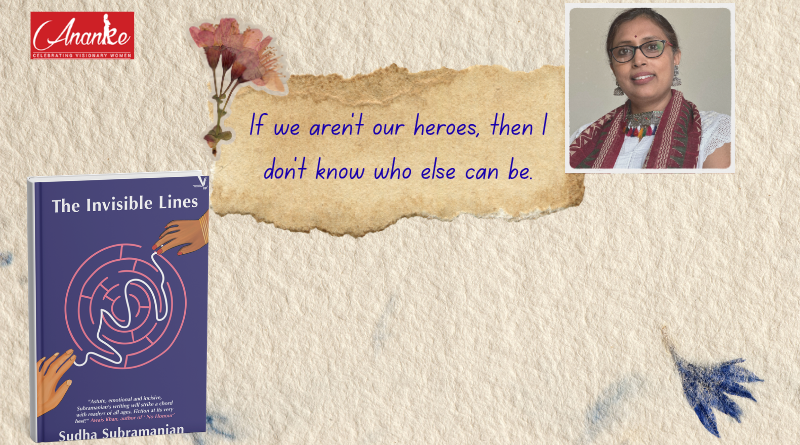
Sudha Subramanian lives in Dubai with her husband. She was a columnist in Gulf News for over fifteen years. Her articles and opinion pieces have been published widely in many newspapers and magazines while her short stories have appeared in many Indian and international literary magazines.
Her flash fiction was nominated for inclusion in the Best of the Net Anthology for three years in a row. Sudha is an alumna of Write Beyond Borders, a prestigious mentoring project for emerging writers of South Asia. She is an amateur birder and a tree hugger.
About the Book:
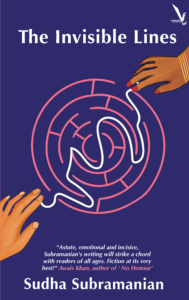
Shashi was married once, but an unexpected encounter with a sexagenarian paediatrician, reignites all her suppressed desires. If the invisible lines are leading her on a path to the ubiquitous “happily ever after”, Shashi has to stand up to the challenge, face the dark secret. She has to seize the moment, write her destiny because she will soon turn sixty and she cannot waste any more time.
Team Ananke: The Invisible Lines (Vishwakarma Publications, 2026) explores romantic desire in later life, a subject still rarely centred in mainstream fiction. Why was it important for you to tell this story now?
Sudha Subramanian: Love is not one colour. In this world of rainbow colours, this story should bring forth ageing men and women to live life actively, sincerely, without having to conform to traditional roles, which is why this subject matter is relevant more than ever before.
Read an exclusive review of The Invisible Lines by Sudha Subramanian
Team Ananke: Shashi appears to be confronting not only society’s expectations but also the invisible rules she has imposed upon herself. Do you think women are often conditioned to silence their emotional needs as they age?
Sudha Subramanian: Traditionally, women have been relegated to being nurturers. ’Others before self’ has always been the motto. We have been raised to conform to those roles. Most women aren’t even aware they can champion their needs over others. If we aren’t our heroes, then I don’t know who else can be. And as we age, we sacrifice our material, emotional and physical needs because we have never been taught to take care of ourselves.
One of the most defining moments of the novel is when Shashi realises, it isn’t such a bad thing if she caters to her wishes! On the contrary, nobody would question a man if he were selfish.
Team Ananke: The novel challenges the idea that fulfilment has an expiry date. Were you consciously trying to redefine what a coming-of-age story can look like?
Sudha Subramanian: All that I was trying to do was tell a story – a story of love where desire, fulfilment has no bar. There was nothing else to it. The rest, the readers decide.
Team Ananke: There is a dark secret at the heart of Shashi’s emotional journey. How important was the idea of confronting the past before embracing personal freedom?
Sudha Subramanian: Shashi had a choice, and for many years, it lingered in the background, threatening her, stifling her. But when a new road appeared, and she decided to embark on a new path, she had to liberate herself from the clutches to enjoy her newfound freedom. In the strangest of ways, she was looking for a clean start, which meant, she had to confront the past.
Team Ananke: Did you anticipate resistance or discomfort from readers when writing openly about desire and companionship in one’s sixties?
Sudha Subramanian: My mother was one of the first readers of my first draft. When she didn’t report any discomfort or resistance, I didn’t think anybody else would have any problem. Besides, we are slowly opening up as a society and are becoming aware of individual needs and wants. And as story-tellers, we have a responsibility to break down walls, reveal new worlds.
Team Ananke: The title, The Invisible Lines is evocative and layered. What kinds of boundaries does the title refer to for you?
Sudha Subramanian: The Invisible Lines represent the lines of fate, destiny. When I wrote the first draft, I thought of this magical moment of the stars aligning perfectly in the sky and granting me words. For me, these lines aren’t boundaries, they are connections, lines that connect person to person and forge new paths.
Team Ananke: What kind of conversations have you most enjoyed having with readers since the book’s release?
Sudha Subramanian: Ever since the book’s release, people have asked me many questions, mainly about publishing. Some interesting ones have been about Shashi. Some readers find it hard to believe that Shashi and Eshwar are imagined characters. But mostly nobody understands it took me five years to write.
Apart from that, readers have found it enjoyable when I share certain processes about writing this novel – like sketches, mood boards, Shashi’s sarees, or her favourite drink . But the most memorable one has been about movie adaptation and who would play Shashi and Eshwar – now that’s something that I haven’t been able to move away from.








)